
tensorflow模拟非线性回归
引入tensoflow,安装的v2版本但要使用v1的会话import tensorflow.compat.v1 as tfimport numpy as npimport matplotlib.pyplot as plttf.disable_v2_behavior()# numpy生成200个随机点x_data = np.linspace(-0.5,0.5,200)[:,np.newaxis]no
·
- 引入tensoflow,安装的v2版本但要使用v1的会话
import tensorflow.compat.v1 as tf
import numpy as np
import matplotlib.pyplot as plt
tf.disable_v2_behavior()
# numpy生成200个随机点
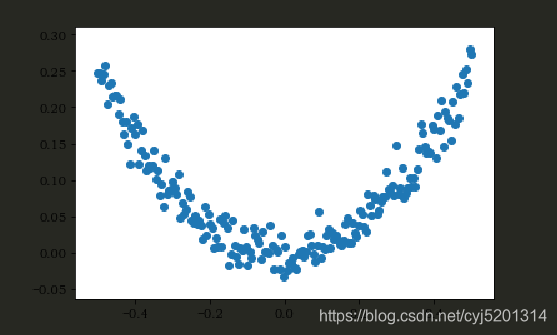
x_data = np.linspace(-0.5,0.5,200)[:,np.newaxis]
noise = np.random.normal(0,0.02,x_data.shape)
y_data = np.square(x_data) + noise

plt.scatter(x_data, y_data)
plt.show()
# 定义两个placeholder
x = tf.placeholder(tf.float32,[None,1])
y = tf.placeholder(tf.float32,[None,1])

# 神经网络结构:1-30-1
w1 = tf.Variable(tf.random_normal([1,30]))
b1 = tf.Variable(tf.zeros([30]))
wx_plus_b_1 = tf.matmul(x,w1) + b1
l1 = tf.nn.tanh(wx_plus_b_1)

w2 = tf.Variable(tf.random_normal([30,1]))
b2 = tf.Variable(tf.zeros([1]))
wx_plus_b_2 = tf.matmul(l1,w2) + b2
prediction = tf.nn.tanh(wx_plus_b_2)

# 二次代价函数
loss = tf.losses.mean_squared_error(y,prediction)
# 使用梯度下降法最小化loss
train = tf.train.GradientDescentOptimizer(0.1).minimize(loss)

with tf.Session() as sess:
    # 变量初始化
    sess.run(tf.global_variables_initializer())
    for _ in range(5000):
        sess.run(train,feed_dict={x:x_data,y:y_data})

    # 获得预测值
    prediction_value = sess.run(prediction,feed_dict={x:x_data})
    # 画图
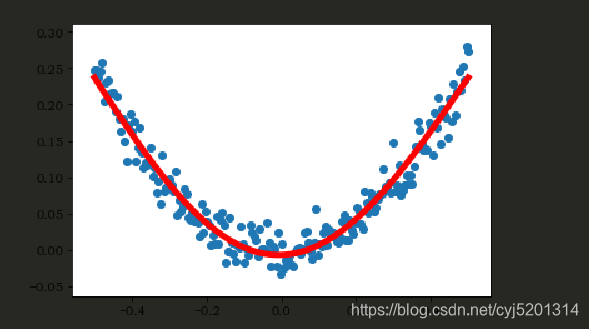
    plt.scatter(x_data, y_data)
    plt.plot(x_data, prediction_value, 'r-', lw=5)
    plt.show()

汇聚全球AI编程工具,助力开发者即刻编程。
更多推荐


 0
0 0
0- 0


 已为社区贡献1条内容

所有评论(0)