
泰山派3M-RK3576-Ai应用-YOLO11-姿态模型
YOLO11介绍
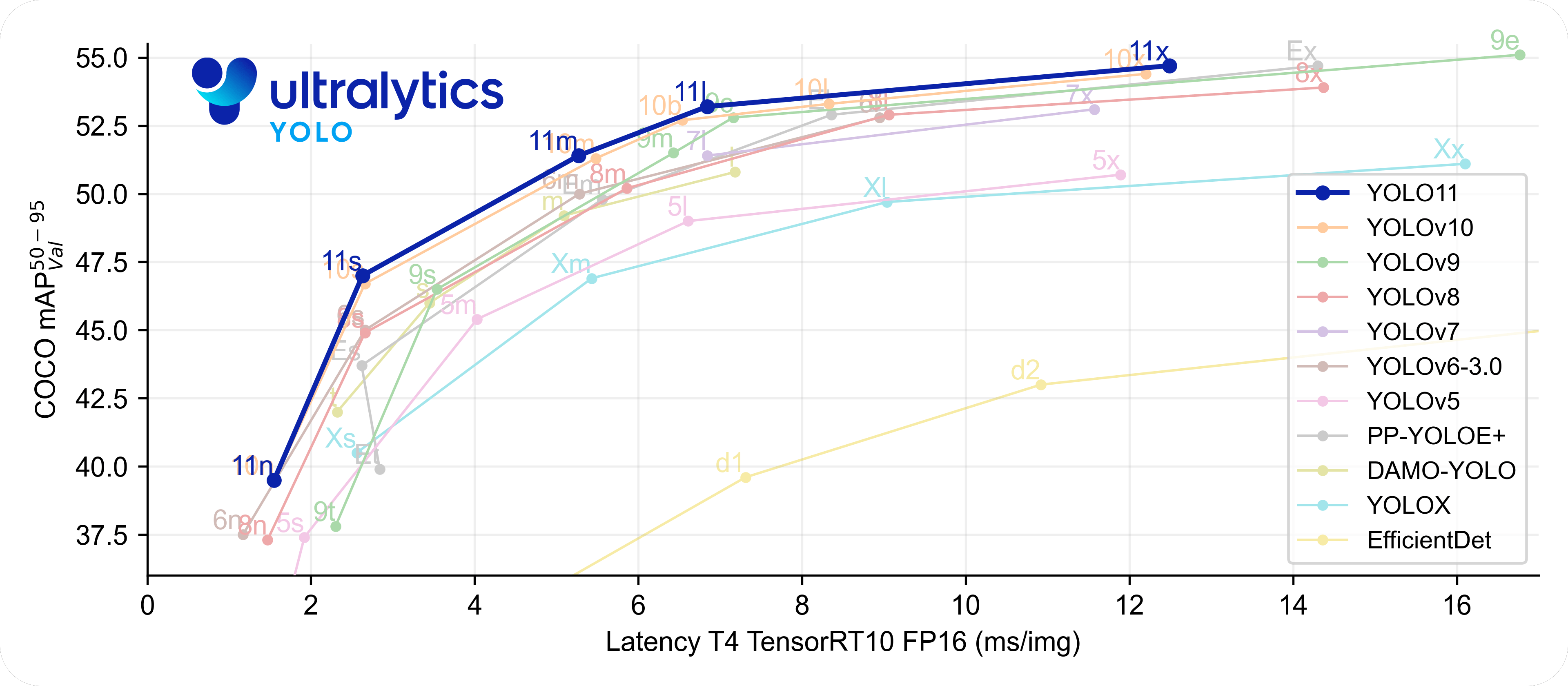
YOLO11 是 Ultralytics 体系的新一代 YOLO 目标检测/分割/姿态等任务模型迭代版本,延续了 YOLO 系列“一阶段、端到端、实时”的设计思路,通过改进网络结构、特征融合与训练/推理策略,在同等算力下提升精度与速度的权衡,并提供从 n/s/m/l/x 等不同规模以适配端侧到服务器的部署需求。
💡 提示
在 YOLO 相关模型命名里,n / s / m / l / x 这类字母通常表示模型规模(size) ,也就是网络的宽度/深度配置不同,带来参数量、计算量和精度/速度的权衡。
常见含义:
- n = nano:最小、最快、精度相对低,适合端侧/低算力
- s = small:小型
- m = medium:中型
- l = large:大型
- x = xlarge / extra-large:最大、最慢、精度通常最
目标
我们将部署模型到泰山派3M-RK3576板子上,使用 rknn_model_zoo 的官方Demo进行演示。
环境准备
- 主机环境:Ubuntu22.04(x86)
- 开发板:泰山派3M-RK3576
- 数据线:连接PC和开发板用于ADB传输文件。
安装miniforge3
为了防止在一个主机中不同的环境造成的 python 环境问题,我们使用 miniforge3 管理。
安装 miniforge3 :
# YOLO11-姿态模型
wget -c https://mirrors.bfsu.edu.cn/github-release/conda-forge/miniforge/LatestRelease/Miniforge3-Linux-x86_64.sh

# 运行安装脚本
bash Miniforge3-Linux-x86_64.sh

# 1.按下Enter回车继续运行
# 2.然后使用向下箭头,向下滚动查看协议
# 3.最后输入yes
# 4.提示Proceed with initialization?输入yes
可以去 https://mirrors.bfsu.edu.cn/github-release/conda-forge/miniforge/LatestRelease/ 这个目录下查看目前最新的 .sh 文件名。
初始化 conda 环境变量:
source ~/miniforge3/bin/activate
成功之后,命令行前方会显示一个
(base)
创建rknn-toolkit2环境
创建并激活 Conda 环境:YOLO11-RKNN-Toolkit2(这里推荐使用 python 3.10 版本)
后面我们将ONNX模型转化为RKNN模型的时候需要用到。
# 创建环境
conda create -n YOLO11-RKNN-Toolkit2 python=3.10

# 遇到Proceed ([y]/n)?
# 输入y即可
激活 Conda 环境:
conda activate YOLO11-RKNN-Toolkit2

# 激活之后在命令行前面会出现:(YOLO11-RKNN-Toolkit2)
安装依赖环境:
# 安装rknn-toolkit2
pip install rknn-toolkit2 -i https://mirrors.aliyun.com/pypi/simple

# 安装指定版本onnx==1.18.0
pip install onnx==1.18.0 -i https://mirrors.aliyun.com/pypi/simple
安装完成之后,退出 YOLO11-RKNN-Toolkit2 环境:
conda deactivate
创建yolo11环境
创建并激活 Conda 环境:Tspi3-YOLO11(这里推荐使用 python 3.10 版本)
# 创建环境
conda create -n Tspi3-YOLO11 python=3.10

# 遇到Proceed ([y]/n)?
# 输入y即可
激活 Conda 环境:
conda activate Tspi3-YOLO11

# 激活之后在命令行前面会出现:(TaishanPi3-YOLO11)
安装依赖工具,为 YOLO11 做准备:
pip install ultralytics onnx onnxscript -i https://mirrors.aliyun.com/pypi/simple
测试:
(Tspi3-YOLO11) lipeng@host:~/workspace$ yolo -v
8.3.248
模型转换
接下来我么需要执行三个重要的步骤:
- 拉取pt文件。
- 使用rockchip优化过的yolo11项目导出onnx模型。
- 使用rknn-toolkit2将onnx模型转化为能硬件加速的RKNN模型。
拉取pt文件
所谓的 .pt 文件,就是训练好的 YOLO11 模型权重(参数),只有拿到这个文件,才能去识别目标。
否则即使有 YOLO11 的代码,也只是一个空架子,无法完成检测。
在 https://github.com/ultralytics/assets/releases/ 这个地址中,有着 ultralytics 官方给我们提供的 .pt 权重文件,我们只需要下载需要的:
wget https://github.com/ultralytics/assets/releases/download/v8.3.0/yolo11n-pose.pt
导出ONNX模型
我们接下来就要拉取 Rockchip 官方修改的 ultralytics_yolo11项目,针对 RKNPU 进行了专门的适配:
- 修改输出结构, 移除后处理结构. (后处理结果对于量化不友好)
- dfl 结构在 NPU 处理上性能不佳,移至模型外部的后处理阶段,此操作大部分情况下可提升推理性能。
- 模型输出分支新增置信度的总和,用于后处理阶段加速阈值筛选。
详情:https://github.com/airockchip/ultralytics_yolo11/blob/main/RKOPT_README.zh-CN.md
继续使用 Tspi3-YOLO11 环境:
conda activate Tspi3-YOLO11
拉取 airockchip/ultralytics_yolo11 项目:
git clone https://github.com/airockchip/ultralytics_yolo11.git
拉取完成之后,进入目录:
cd ultralytics_yolo11
修改 ultralytics_yolo11/ultralytics/cfg/default.yaml 文件中的 model 为刚刚拉取的 .pt 文件绝对路径:
要根据自己的
.pt文件路径,进行填写。
# Train settings -------------------------------------------------------------------------------------------------------
-model: yolo11n.pt # (str, optional) path to model file, i.e. yolo11n.pt, yolo11n.yaml
+model: /home/lipeng/workspace/yolo11/yolo11n-pose.pt # (str, optional) path to model file, i.e. yolo11n.pt, yolo11n.yaml
 data: # (str, optional) path to data file, i.e. coco8.yaml
 epochs: 100 # (int) number of epochs to train for
 time: # (float, optional) number of hours to train for, overrides epochs if supplied
修改 ultralytics_yolo11/ultralytics/engine/exporter.py 文件,添加 dynamo=False 参数,强制使用旧版 TorchScript-based 的 ONNX 导出器,防止最新版本的 PyTorch 导出 pose 的 ONNX 模型报错:
--- a/ultralytics/engine/exporter.py
+++ b/ultralytics/engine/exporter.py
@@ -413,6 +413,7 @@ class Exporter:
             f,
             verbose=False,
             opset_version=12,
+            dynamo=False,  # Use legacy TorchScript-based exporter for compatibility
             do_constant_folding=True,  # WARNING: DNN inference with torch>=1.12 may require do_constant_folding=False
             input_names=['images'])
设置导出路径为当前目录:
export PYTHONPATH=./
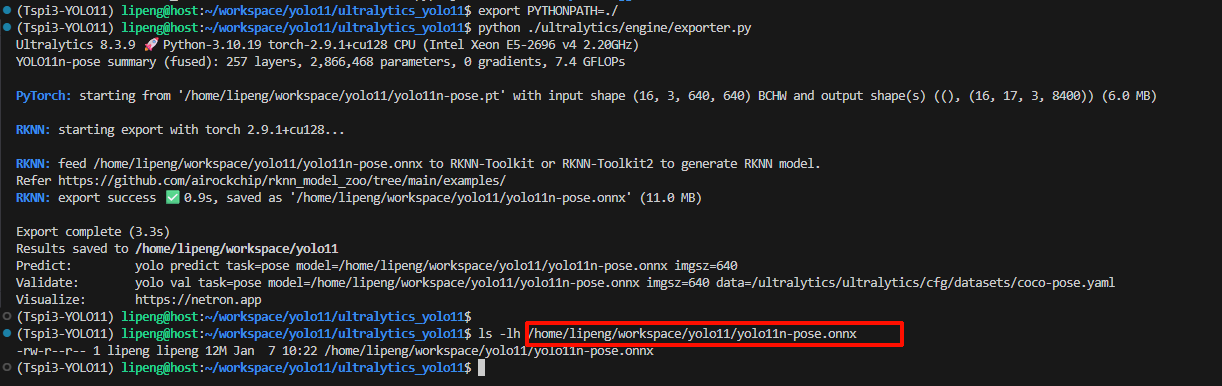
使用脚本开始导出 ONNX模型:
python ./ultralytics/engine/exporter.py
ONNX转RKNN
退出 Tspi3-YOLO11 环境:
conda deactivate
进入YOLO11-RKNN-Toolkit2 环境
conda activate YOLO11-RKNN-Toolkit2
接下来我们将使用 rknn_model_zoo 中的 转换脚本 将 ONNX 转换为 RKNN 模型,拉取项目:
git clone https://github.com/airockchip/rknn_model_zoo.git
进入 rknn_model_zoo/examples/yolov8_pose/python 目录下:
特别注意
因为 YOLO11 没有专门的分割案例,我们直接使用 YOLOv8 的案例即可,
cd rknn_model_zoo/examples/yolov8_pose/python
修改 rknn_model_zoo/examples/yolov8_pose/python/convert.py 脚本,不使用混合量化部分,因为我们导出的ONNX模型层级不同,故而使用标准量化:
--- a/examples/yolov8_pose/python/convert.py
+++ b/examples/yolov8_pose/python/convert.py
@@ -59,23 +59,19 @@ if __name__ == '__main__':
     if platform in ["rv1109","rv1126","rk1808"] :
         ret = rknn.build(do_quantization=do_quant, dataset=DATASET_PATH, auto_hybrid_quant=True)
     else:
-        if do_quant:
-            rknn.hybrid_quantization_step1(
-                dataset=DATASET_PATH,
-                proposal= False,
-                custom_hybrid=[['/model.22/cv4.0/cv4.0.0/act/Mul_output_0','/model.22/Concat_6_output_0'],
-                                ['/model.22/cv4.1/cv4.1.0/act/Mul_output_0','/model.22/Concat_6_output_0'],
-                                ['/model.22/cv4.2/cv4.2.0/act/Mul_output_0','/model.22/Concat_6_output_0']]
-            )
-
-            model_name=os.path.basename(model_path).replace('.onnx','')
-            rknn.hybrid_quantization_step2(
-                model_input = model_name+".model",          # 表示第一步生成的模型文件
-                data_input= model_name+".data",             # 表示第一步生成的配置文件
-                model_quantization_cfg=model_name+".quantization.cfg"  # 表示第一步生成的量化配置文件
-            )
-        else:
-            ret = rknn.build(do_quantization=do_quant, dataset=DATASET_PATH)
+        # Standard quantization (default, fastest)
+        ret = rknn.build(do_quantization=do_quant, dataset=DATASET_PATH)
+
+        # Uncomment below to enable AUTO hybrid quantization (automatically finds sensitive layers):
+        # if do_quant:
+        #     rknn.hybrid_quantization_step1(dataset=DATASET_PATH, proposal=True)
+        #     model_name = os.path.basename(model_path).replace('.onnx','')
+        #     # Check generated .quantization.cfg, adjust if needed, then run:
+        #     rknn.hybrid_quantization_step2(
+        #         model_input=model_name+".model",
+        #         data_input=model_name+".data",
+        #         model_quantization_cfg=model_name+".quantization.cfg"
+        #     )
     if ret != 0:
         print('Build model failed!')
         exit(ret)
运行 rknn_model_zoo/examples/yolov8_pose/python/convert.py 脚本转化RKNN模型:
# 语法:python3 convert.py onnx_model_path [platform] [dtype] [output_rknn_path]
## platform:[rk3562, rk3566, rk3568, rk3576, rk3588, rv1126b, rv1109, rv1126, rk1808]
## dtype:[i8, fp] for [rk3562, rk3566, rk3568, rk3576, rk3588, rv1126b]
## dtype:[u8, fp] for [rv1109, rv1126, rk1808]

python convert.py /home/lipeng/workspace/yolo11/yolo11n-pose.onnx rk3576 i8
platform选择的平台有rk3562,rk3566,rk3568,rk3576,rk3588,rv1126b,rv1109,rv1126,rk1808可选择dtype:
- 选择
i8或fp适用于rk3562,rk3566,rk3568,rk3576,rk3588,rv1126b这些平台- 选择
u8或fp适用于rv1109,rv1126,rk1808这些平台

执行成功之后,会在 rknn_model_zoo/examples/yolov8_pose/model 目录下生成一个 .rknn 模型文件。
Demo编译
说明
在 rockchip官方的开源项目 中使用的是C++编写的Demo,可以通过运行
rknn_model_zoo/build-linux.shrknn_model_zoo/build-android.sh
这两个脚本(将交叉编译路径替换为实际路径)直接编译示例代码。
在部署目录中生成一个install/demo_Linux_aarch64 或 install/demo_Android_aarch64 文件夹,包含 imgenc、llm、demo 和 lib 文件夹。
退出环境
conda deactivate
看到命令行前面出现 (base) 字样就可以了。
安装交叉编译器
我们需要在PC主机上面编译Demo生成文件,在泰山派3M-RK3576的板子上面运行,所以我们直接使用 apt 安装 aarch64-linux-gnu:
sudo apt update && \
sudo apt install -y cmake make gcc-aarch64-linux-gnu g++-aarch64-linux-gnu
修改Demo源码
在原有的 YOLOv8 的 pose 姿态检 Demo 中代码使用 float16 读取关键点数据。输出层是 INT8 类型,因此必须使用 INT8 的反量化。
修改 rknn_model_zoo/examples/yolov8_pose/cpp/postprocess.cc 文件:
diffpostprocess.cc
diff --git a/examples/yolov8_pose/cpp/postprocess.cc b/examples/yolov8_pose/cpp/postprocess.cc
index 8d11271..d45cc8f 100644
--- a/examples/yolov8_pose/cpp/postprocess.cc
+++ b/examples/yolov8_pose/cpp/postprocess.cc
@@ -470,30 +470,35 @@ int post_process(rknn_app_context_t *app_ctx, void *outputs, letterbox_t *letter
         float h = filterBoxes[n * 5 + 3];
         int keypoints_index = (int)filterBoxes[n * 5 + 4];

+        // Calculate total anchor points dynamically from output tensor
+        int total_anchors = index; // Total anchor points from all scales
+
         for (int j = 0; j < 17; ++j) {
             if (app_ctx->is_quant) {
                 #ifdef RKNPU1
-                        od_results->results[last_count].keypoints[j][0] = (deqnt_affine_u8_to_f32(((uint8_t *)_outputs[3].buf)[j * 3 * 8400 + 0 * 8400 + keypoints_index],
+                        od_results->results[last_count].keypoints[j][0] = (deqnt_affine_u8_to_f32(((uint8_t *)_outputs[3].buf)[(j * 3 + 0) * total_anchors + keypoints_index],
                                 app_ctx->output_attrs[3].zp, app_ctx->output_attrs[3].scale)- letter_box->x_pad)/ letter_box->scale;
-                        od_results->results[last_count].keypoints[j][1] = (deqnt_affine_u8_to_f32(((uint8_t *)_outputs[3].buf)[j * 3 * 8400 + 1 * 8400 + keypoints_index],
+                        od_results->results[last_count].keypoints[j][1] = (deqnt_affine_u8_to_f32(((uint8_t *)_outputs[3].buf)[(j * 3 + 1) * total_anchors + keypoints_index],
                                 app_ctx->output_attrs[3].zp, app_ctx->output_attrs[3].scale)- letter_box->y_pad)/ letter_box->scale;
-                        od_results->results[last_count].keypoints[j][2] = deqnt_affine_u8_to_f32(((uint8_t *)_outputs[3].buf)[j * 3 * 8400 + 2 * 8400 + keypoints_index],
+                        od_results->results[last_count].keypoints[j][2] = deqnt_affine_u8_to_f32(((uint8_t *)_outputs[3].buf)[(j * 3 + 2) * total_anchors + keypoints_index],
                                 app_ctx->output_attrs[3].zp, app_ctx->output_attrs[3].scale);
                 #else
-                        od_results->results[last_count].keypoints[j][0] = ((float)((rknpu2::float16 *)_outputs[3].buf)[j*3*8400+0*8400+keypoints_index]
-                                                                        - letter_box->x_pad)/ letter_box->scale;
-                        od_results->results[last_count].keypoints[j][1] = ((float)((rknpu2::float16 *)_outputs[3].buf)[j*3*8400+1*8400+keypoints_index]
-                                                                            - letter_box->y_pad)/ letter_box->scale;
-                        od_results->results[last_count].keypoints[j][2] = (float)((rknpu2::float16 *)_outputs[3].buf)[j*3*8400+2*8400+keypoints_index];
+                        // RKNPU2: INT8 quantized output, use deqnt_affine_to_f32
+                        od_results->results[last_count].keypoints[j][0] = (deqnt_affine_to_f32(((int8_t *)_outputs[3].buf)[(j*3+0)*total_anchors+keypoints_index],
+                                app_ctx->output_attrs[3].zp, app_ctx->output_attrs[3].scale) - letter_box->x_pad) / letter_box->scale;
+                        od_results->results[last_count].keypoints[j][1] = (deqnt_affine_to_f32(((int8_t *)_outputs[3].buf)[(j*3+1)*total_anchors+keypoints_index],
+                                app_ctx->output_attrs[3].zp, app_ctx->output_attrs[3].scale) - letter_box->y_pad) / letter_box->scale;
+                        od_results->results[last_count].keypoints[j][2] = deqnt_affine_to_f32(((int8_t *)_outputs[3].buf)[(j*3+2)*total_anchors+keypoints_index],
+                                app_ctx->output_attrs[3].zp, app_ctx->output_attrs[3].scale);
                 #endif
             }
             else
             {
-                od_results->results[last_count].keypoints[j][0] = (((float *)_outputs[3].buf)[j*3*8400+0*8400+keypoints_index]
+                od_results->results[last_count].keypoints[j][0] = (((float *)_outputs[3].buf)[(j*3+0)*total_anchors+keypoints_index]
                                                                 - letter_box->x_pad)/ letter_box->scale;
-                od_results->results[last_count].keypoints[j][1] = (((float *)_outputs[3].buf)[j*3*8400+1*8400+keypoints_index]
+                od_results->results[last_count].keypoints[j][1] = (((float *)_outputs[3].buf)[(j*3+1)*total_anchors+keypoints_index]
                                                                     - letter_box->y_pad)/ letter_box->scale;
-                od_results->results[last_count].keypoints[j][2] = ((float *)_outputs[3].buf)[j*3*8400+2*8400+keypoints_index];
+                od_results->results[last_count].keypoints[j][2] = ((float *)_outputs[3].buf)[(j*3+2)*total_anchors+keypoints_index];
             }
         }
// Copyright (c) 2024 by Rockchip Electronics Co., Ltd. All Rights Reserved.
//
// Licensed under the Apache License, Version 2.0 (the "License");
// you may not use this file except in compliance with the License.
// You may obtain a copy of the License at
//
// http://www.apache.org/licenses/LICENSE-2.0
//
// Unless required by applicable law or agreed to in writing, software
// distributed under the License is distributed on an "AS IS" BASIS,
// WITHOUT WARRANTIES OR CONDITIONS OF ANY KIND, either express or implied.
// See the License for the specific language governing permissions and
// limitations under the License.
#include "yolov8-pose.h"
#include <math.h>
#include <stdint.h>
#include <stdio.h>
#include <stdlib.h>
#include <string.h>
#include <sys/time.h>
#ifndef RKNPU1
#include <Float16.h>
#endif
#include <iostream>
#include <cmath>
#include <algorithm>
#include <set>
#include <vector>
#define LABEL_NALE_TXT_PATH "./model/yolov8_pose_labels_list.txt"
static char *labels[OBJ_CLASS_NUM];
inline static int clamp(float val, int min, int max) { return val > min ? (val < max ? val : max) : min; }
static char *readLine(FILE *fp, char *buffer, int *len) {
int ch;
int i = 0;
size_t buff_len = 0;
buffer = (char *)malloc(buff_len + 1);
if (!buffer)
return NULL; // Out of memory
while ((ch = fgetc(fp)) != '\n' && ch != EOF) {
buff_len++;
void *tmp = realloc(buffer, buff_len + 1);
if (tmp == NULL) {
free(buffer);
return NULL; // Out of memory
}
buffer = (char *)tmp;
buffer[i] = (char)ch;
i++;
}
buffer[i] = '\0';
*len = buff_len;
// Detect end
if (ch == EOF && (i == 0 || ferror(fp))) {
free(buffer);
return NULL;
}
return buffer;
}
static int readLines(const char *fileName, char *lines[], int max_line) {
FILE *file = fopen(fileName, "r");
char *s;
int i = 0;
int n = 0;
if (file == NULL) {
printf("Open %s fail!\n", fileName);
return -1;
}
while ((s = readLine(file, s, &n)) != NULL) {
lines[i++] = s;
if (i >= max_line)
break;
}
fclose(file);
return i;
}
static int loadLabelName(const char *locationFilename, char *label[]) {
printf("load lable %s\n", locationFilename);
readLines(locationFilename, label, OBJ_CLASS_NUM);
return 0;
}
static float CalculateOverlap(float xmin0, float ymin0, float xmax0, float ymax0, float xmin1, float ymin1, float xmax1,
float ymax1)
{
float w = fmax(0.f, fmin(xmax0, xmax1) - fmax(xmin0, xmin1) + 1.0);
float h = fmax(0.f, fmin(ymax0, ymax1) - fmax(ymin0, ymin1) + 1.0);
float i = w * h;
float u = (xmax0 - xmin0 + 1.0) * (ymax0 - ymin0 + 1.0) + (xmax1 - xmin1 + 1.0) * (ymax1 - ymin1 + 1.0) - i;
return u <= 0.f ? 0.f : (i / u);
}
static int nms(int validCount, std::vector<float> &outputLocations, std::vector<int> classIds, std::vector<int> &order,
int filterId, float threshold)
{
for (int i = 0; i < validCount; ++i)
{
int n = order[i];
if (n == -1 || classIds[n] != filterId)
{
continue;
}
for (int j = i + 1; j < validCount; ++j)
{
int m = order[j];
if (m == -1 || classIds[m] != filterId)
{
continue;
}
float xmin0 = outputLocations[n * 5 + 0];
float ymin0 = outputLocations[n * 5 + 1];
float xmax0 = outputLocations[n * 5 + 0] + outputLocations[n * 5 + 2];
float ymax0 = outputLocations[n * 5 + 1] + outputLocations[n * 5 + 3];
float xmin1 = outputLocations[m * 5 + 0];
float ymin1 = outputLocations[m * 5 + 1];
float xmax1 = outputLocations[m * 5 + 0] + outputLocations[m * 5 + 2];
float ymax1 = outputLocations[m * 5 + 1] + outputLocations[m * 5 + 3];
float iou = CalculateOverlap(xmin0, ymin0, xmax0, ymax0, xmin1, ymin1, xmax1, ymax1);
if (iou > threshold)
{
order[j] = -1;
}
}
}
return 0;
}
static int quick_sort_indice_inverse(std::vector<float> &input, int left, int right, std::vector<int> &indices) {
float key;
int key_index;
int low = left;
int high = right;
if (left < right) {
key_index = indices[left];
key = input[left];
while (low < high) {
while (low < high && input[high] <= key) {
high--;
}
input[low] = input[high];
indices[low] = indices[high];
while (low < high && input[low] >= key) {
low++;
}
input[high] = input[low];
indices[high] = indices[low];
}
input[low] = key;
indices[low] = key_index;
quick_sort_indice_inverse(input, left, low - 1, indices);
quick_sort_indice_inverse(input, low + 1, right, indices);
}
return low;
}
static float sigmoid(float x) {
return 1.0 / (1.0 + expf(-x));
}
static float unsigmoid(float y) {
return -1.0 * logf((1.0 / y) - 1.0);
}
inline static int32_t __clip(float val, float min, float max) {
float f = val <= min ? min : (val >= max ? max : val);
return f;
}
static int8_t qnt_f32_to_affine(float f32, int32_t zp, float scale) {
float dst_val = (f32 / scale) + zp;
int8_t res = (int8_t)__clip(dst_val, -128, 127);
return res;
}
static uint8_t qnt_f32_to_affine_u8(float f32, int32_t zp, float scale) {
float dst_val = (f32 / scale) + zp;
uint8_t res = (uint8_t)__clip(dst_val, 0, 255);
return res;
}
static float deqnt_affine_to_f32(int8_t qnt, int32_t zp, float scale) {
return ((float)qnt - (float)zp) * scale;
}
static float deqnt_affine_u8_to_f32(uint8_t qnt, int32_t zp, float scale) {
return ((float)qnt - (float)zp) * scale;
}
void softmax(float *input, int size) {
float max_val = input[0];
for (int i = 1; i < size; ++i) {
if (input[i] > max_val) {
max_val = input[i];
}
}
float sum_exp = 0.0;
for (int i = 0; i < size; ++i) {
sum_exp += expf(input[i] - max_val);
}
for (int i = 0; i < size; ++i) {
input[i] = expf(input[i] - max_val) / sum_exp;
}
}
static int process_i8(int8_t *input, int grid_h, int grid_w, int stride,
std::vector<float> &boxes, std::vector<float> &boxScores, std::vector<int> &classId, float threshold,
int32_t zp, float scale, int index) {
int input_loc_len = 64;
int tensor_len = input_loc_len + OBJ_CLASS_NUM;
int validCount = 0;
int8_t thres_i8 = qnt_f32_to_affine(unsigmoid(threshold), zp, scale);
for (int h = 0; h < grid_h; h++) {
for (int w = 0; w < grid_w; w++) {
for (int a = 0; a < OBJ_CLASS_NUM; a++) {
if(input[(input_loc_len + a)*grid_w * grid_h + h * grid_w + w ] >= thres_i8) { //[1,tensor_len,grid_h,grid_w]
float box_conf_f32 = sigmoid(deqnt_affine_to_f32(input[(input_loc_len + a) * grid_w * grid_h + h * grid_w + w ],
zp, scale));
float loc[input_loc_len];
for (int i = 0; i < input_loc_len; ++i) {
loc[i] = deqnt_affine_to_f32(input[i * grid_w * grid_h + h * grid_w + w], zp, scale);
}
for (int i = 0; i < input_loc_len / 16; ++i) {
softmax(&loc[i * 16], 16);
}
float xywh_[4] = {0, 0, 0, 0};
float xywh[4] = {0, 0, 0, 0};
for (int dfl = 0; dfl < 16; ++dfl) {
xywh_[0] += loc[dfl] * dfl;
xywh_[1] += loc[1 * 16 + dfl] * dfl;
xywh_[2] += loc[2 * 16 + dfl] * dfl;
xywh_[3] += loc[3 * 16 + dfl] * dfl;
}
xywh_[0]=(w+0.5)-xywh_[0];
xywh_[1]=(h+0.5)-xywh_[1];
xywh_[2]=(w+0.5)+xywh_[2];
xywh_[3]=(h+0.5)+xywh_[3];
xywh[0]=((xywh_[0]+xywh_[2])/2)*stride;
xywh[1]=((xywh_[1]+xywh_[3])/2)*stride;
xywh[2]=(xywh_[2]-xywh_[0])*stride;
xywh[3]=(xywh_[3]-xywh_[1])*stride;
xywh[0]=xywh[0]-xywh[2]/2;
xywh[1]=xywh[1]-xywh[3]/2;
boxes.push_back(xywh[0]);//x
boxes.push_back(xywh[1]);//y
boxes.push_back(xywh[2]);//w
boxes.push_back(xywh[3]);//h
boxes.push_back(float(index + (h * grid_w) + w));//keypoints index
boxScores.push_back(box_conf_f32);
classId.push_back(a);
validCount++;
}
}
}
}
return validCount;
}
static int process_u8(uint8_t *input, int grid_h, int grid_w, int stride,
std::vector<float> &boxes, std::vector<float> &boxScores, std::vector<int> &classId, float threshold,
int32_t zp, float scale, int index) {
int input_loc_len = 64;
int tensor_len = input_loc_len + OBJ_CLASS_NUM;
int validCount = 0;
uint8_t thres_i8 = qnt_f32_to_affine_u8(unsigmoid(threshold), zp, scale);
for (int h = 0; h < grid_h; h++) {
for (int w = 0; w < grid_w; w++) {
for (int a = 0; a < OBJ_CLASS_NUM; a++) {
if(input[(input_loc_len + a)*grid_w * grid_h + h * grid_w + w ] >= thres_i8) { //[1,tensor_len,grid_h,grid_w]
float box_conf_f32 = sigmoid(deqnt_affine_u8_to_f32(input[(input_loc_len + a) * grid_w * grid_h + h * grid_w + w ],
zp, scale));
float loc[input_loc_len];
for (int i = 0; i < input_loc_len; ++i) {
loc[i] = deqnt_affine_u8_to_f32(input[i * grid_w * grid_h + h * grid_w + w], zp, scale);
}
for (int i = 0; i < input_loc_len / 16; ++i) {
softmax(&loc[i * 16], 16);
}
float xywh_[4] = {0, 0, 0, 0};
float xywh[4] = {0, 0, 0, 0};
for (int dfl = 0; dfl < 16; ++dfl) {
xywh_[0] += loc[dfl] * dfl;
xywh_[1] += loc[1 * 16 + dfl] * dfl;
xywh_[2] += loc[2 * 16 + dfl] * dfl;
xywh_[3] += loc[3 * 16 + dfl] * dfl;
}
xywh_[0]=(w+0.5)-xywh_[0];
xywh_[1]=(h+0.5)-xywh_[1];
xywh_[2]=(w+0.5)+xywh_[2];
xywh_[3]=(h+0.5)+xywh_[3];
xywh[0]=((xywh_[0]+xywh_[2])/2)*stride;
xywh[1]=((xywh_[1]+xywh_[3])/2)*stride;
xywh[2]=(xywh_[2]-xywh_[0])*stride;
xywh[3]=(xywh_[3]-xywh_[1])*stride;
xywh[0]=xywh[0]-xywh[2]/2;
xywh[1]=xywh[1]-xywh[3]/2;
boxes.push_back(xywh[0]);//x
boxes.push_back(xywh[1]);//y
boxes.push_back(xywh[2]);//w
boxes.push_back(xywh[3]);//h
boxes.push_back(float(index + (h * grid_w) + w));//keypoints index
boxScores.push_back(box_conf_f32);
classId.push_back(a);
validCount++;
}
}
}
}
return validCount;
}
static int process_fp32(float *input, int grid_h, int grid_w, int stride,
std::vector<float> &boxes, std::vector<float> &boxScores, std::vector<int> &classId, float threshold,
int32_t zp, float scale, int index) {
int input_loc_len = 64;
int tensor_len = input_loc_len + OBJ_CLASS_NUM;
int validCount = 0;
float thres_fp = unsigmoid(threshold);
for (int h = 0; h < grid_h; h++) {
for (int w = 0; w < grid_w; w++) {
for (int a = 0; a < OBJ_CLASS_NUM; a++) {
if(input[(input_loc_len + a)*grid_w * grid_h + h * grid_w + w ] >= thres_fp) { //[1,tensor_len,grid_h,grid_w]
float box_conf_f32 = sigmoid(input[(input_loc_len + a) * grid_w * grid_h + h * grid_w + w ]);
float loc[input_loc_len];
for (int i = 0; i < input_loc_len; ++i) {
loc[i] = input[i * grid_w * grid_h + h * grid_w + w];
}
for (int i = 0; i < input_loc_len / 16; ++i) {
softmax(&loc[i * 16], 16);
}
float xywh_[4] = {0, 0, 0, 0};
float xywh[4] = {0, 0, 0, 0};
for (int dfl = 0; dfl < 16; ++dfl) {
xywh_[0] += loc[dfl] * dfl;
xywh_[1] += loc[1 * 16 + dfl] * dfl;
xywh_[2] += loc[2 * 16 + dfl] * dfl;
xywh_[3] += loc[3 * 16 + dfl] * dfl;
}
xywh_[0]=(w+0.5)-xywh_[0];
xywh_[1]=(h+0.5)-xywh_[1];
xywh_[2]=(w+0.5)+xywh_[2];
xywh_[3]=(h+0.5)+xywh_[3];
xywh[0]=((xywh_[0]+xywh_[2])/2)*stride;
xywh[1]=((xywh_[1]+xywh_[3])/2)*stride;
xywh[2]=(xywh_[2]-xywh_[0])*stride;
xywh[3]=(xywh_[3]-xywh_[1])*stride;
xywh[0]=xywh[0]-xywh[2]/2;
xywh[1]=xywh[1]-xywh[3]/2;
boxes.push_back(xywh[0]);//x
boxes.push_back(xywh[1]);//y
boxes.push_back(xywh[2]);//w
boxes.push_back(xywh[3]);//h
boxes.push_back(float(index + (h * grid_w) + w));//keypoints index
boxScores.push_back(box_conf_f32);
classId.push_back(a);
validCount++;
}
}
}
}
return validCount;
}
int post_process(rknn_app_context_t *app_ctx, void *outputs, letterbox_t *letter_box, float conf_threshold, float nms_threshold,
object_detect_result_list *od_results) {
#if defined(RV1106_1103)
rknn_tensor_mem **_outputs = (rknn_tensor_mem **)outputs;
#else
rknn_output *_outputs = (rknn_output *)outputs;
#endif
std::vector<float> filterBoxes;
std::vector<float> objProbs;
std::vector<int> classId;
int validCount = 0;
int stride = 0;
int grid_h = 0;
int grid_w = 0;
int model_in_w = app_ctx->model_width;
int model_in_h = app_ctx->model_height;
memset(od_results, 0, sizeof(object_detect_result_list));
int index = 0;
#ifdef RKNPU1
for (int i = 0; i < 3; i++) {
grid_h = app_ctx->output_attrs[i].dims[1];
grid_w = app_ctx->output_attrs[i].dims[0];
stride = model_in_h / grid_h;
if (app_ctx->is_quant) {
validCount += process_u8((uint8_t *)_outputs[i].buf, grid_h, grid_w, stride, filterBoxes, objProbs,
classId, conf_threshold, app_ctx->output_attrs[i].zp, app_ctx->output_attrs[i].scale, index);
}
else
{
validCount += process_fp32((float *)_outputs[i].buf, grid_h, grid_w, stride, filterBoxes, objProbs,
classId, conf_threshold, app_ctx->output_attrs[i].zp, app_ctx->output_attrs[i].scale, index);
}
index += grid_h * grid_w;
}
#else
for (int i = 0; i < 3; i++) {
grid_h = app_ctx->output_attrs[i].dims[2];
grid_w = app_ctx->output_attrs[i].dims[3];
stride = model_in_h / grid_h;
if (app_ctx->is_quant) {
validCount += process_i8((int8_t *)_outputs[i].buf, grid_h, grid_w, stride, filterBoxes, objProbs,
classId, conf_threshold, app_ctx->output_attrs[i].zp, app_ctx->output_attrs[i].scale,index);
}
else
{
validCount += process_fp32((float *)_outputs[i].buf, grid_h, grid_w, stride, filterBoxes, objProbs,
classId, conf_threshold, app_ctx->output_attrs[i].zp, app_ctx->output_attrs[i].scale, index);
}
index += grid_h * grid_w;
}
#endif
// no object detect
if (validCount <= 0) {
return 0;
}
std::vector<int> indexArray;
for (int i = 0; i < validCount; ++i) {
indexArray.push_back(i);
}
quick_sort_indice_inverse(objProbs, 0, validCount - 1, indexArray);
std::set<int> class_set(std::begin(classId), std::end(classId));
for (auto c : class_set) {
nms(validCount, filterBoxes, classId, indexArray, c, nms_threshold);
}
int last_count = 0;
od_results->count = 0;
/* box valid detect target */
for (int i = 0; i < validCount; ++i) {
if (indexArray[i] == -1 || last_count >= OBJ_NUMB_MAX_SIZE) {
continue;
}
int n = indexArray[i];
float x1 = filterBoxes[n * 5 + 0] - letter_box->x_pad;
float y1 = filterBoxes[n * 5 + 1] - letter_box->y_pad;
float w = filterBoxes[n * 5 + 2];
float h = filterBoxes[n * 5 + 3];
int keypoints_index = (int)filterBoxes[n * 5 + 4];
// Calculate total anchor points dynamically from output tensor
int total_anchors = index; // Total anchor points from all scales
for (int j = 0; j < 17; ++j) {
if (app_ctx->is_quant) {
#ifdef RKNPU1
od_results->results[last_count].keypoints[j][0] = (deqnt_affine_u8_to_f32(((uint8_t *)_outputs[3].buf)[(j * 3 + 0) * total_anchors + keypoints_index],
app_ctx->output_attrs[3].zp, app_ctx->output_attrs[3].scale)- letter_box->x_pad)/ letter_box->scale;
od_results->results[last_count].keypoints[j][1] = (deqnt_affine_u8_to_f32(((uint8_t *)_outputs[3].buf)[(j * 3 + 1) * total_anchors + keypoints_index],
app_ctx->output_attrs[3].zp, app_ctx->output_attrs[3].scale)- letter_box->y_pad)/ letter_box->scale;
od_results->results[last_count].keypoints[j][2] = deqnt_affine_u8_to_f32(((uint8_t *)_outputs[3].buf)[(j * 3 + 2) * total_anchors + keypoints_index],
app_ctx->output_attrs[3].zp, app_ctx->output_attrs[3].scale);
#else
// RKNPU2: INT8 quantized output, use deqnt_affine_to_f32
od_results->results[last_count].keypoints[j][0] = (deqnt_affine_to_f32(((int8_t *)_outputs[3].buf)[(j*3+0)*total_anchors+keypoints_index],
app_ctx->output_attrs[3].zp, app_ctx->output_attrs[3].scale) - letter_box->x_pad) / letter_box->scale;
od_results->results[last_count].keypoints[j][1] = (deqnt_affine_to_f32(((int8_t *)_outputs[3].buf)[(j*3+1)*total_anchors+keypoints_index],
app_ctx->output_attrs[3].zp, app_ctx->output_attrs[3].scale) - letter_box->y_pad) / letter_box->scale;
od_results->results[last_count].keypoints[j][2] = deqnt_affine_to_f32(((int8_t *)_outputs[3].buf)[(j*3+2)*total_anchors+keypoints_index],
app_ctx->output_attrs[3].zp, app_ctx->output_attrs[3].scale);
#endif
}
else
{
od_results->results[last_count].keypoints[j][0] = (((float *)_outputs[3].buf)[(j*3+0)*total_anchors+keypoints_index]
- letter_box->x_pad)/ letter_box->scale;
od_results->results[last_count].keypoints[j][1] = (((float *)_outputs[3].buf)[(j*3+1)*total_anchors+keypoints_index]
- letter_box->y_pad)/ letter_box->scale;
od_results->results[last_count].keypoints[j][2] = ((float *)_outputs[3].buf)[(j*3+2)*total_anchors+keypoints_index];
}
}
int id = classId[n];
float obj_conf = objProbs[i];
od_results->results[last_count].box.left = (int)(clamp(x1, 0, model_in_w) / letter_box->scale);
od_results->results[last_count].box.top = (int)(clamp(y1, 0, model_in_h) / letter_box->scale);
od_results->results[last_count].box.right = (int)(clamp(x1+w, 0, model_in_w) / letter_box->scale);
od_results->results[last_count].box.bottom = (int)(clamp(y1+h, 0, model_in_h) / letter_box->scale);
// od_results->results[last_count].box.angle = angle;
od_results->results[last_count].prop = obj_conf;
od_results->results[last_count].cls_id = id;
last_count++;
}
od_results->count = last_count;
return 0;
}
int init_post_process() {
int ret = 0;
ret = loadLabelName(LABEL_NALE_TXT_PATH, labels);
if (ret < 0) {
printf("Load %s failed!\n", LABEL_NALE_TXT_PATH);
return -1;
}
return 0;
}
char *coco_cls_to_name(int cls_id) {
if (cls_id >= OBJ_CLASS_NUM) {
return "null";
}
if (labels[cls_id]) {
return labels[cls_id];
}
return "null";
}
void deinit_post_process() {
for (int i = 0; i < OBJ_CLASS_NUM; i++) {
if (labels[i] != nullptr) {
free(labels[i]);
labels[i] = nullptr;
}
}
}
编译
进入项目目录:
cd rknn_model_zoo/

给予 build-linux.sh 运行权限:
sudo chmod +x ./build-linux.sh
运行编译脚本:
./build-linux.sh -t <target> -a <arch> -d <build_demo_name> [-b <build_type>] [-m] [-r] [-j]
    -t : target (rk356x/rk3576/rk3588/rv1106/rv1126b/rv1126/rk1808)
    -a : arch (aarch64/armhf)
    -d : demo name
    -b : build_type(Debug/Release)
    -m : enable address sanitizer, build_type need set to Debug
    -r : disable rga, use cpu resize image
    -j : disable libjpeg to avoid conflicts between libjpeg and opencv

# 我们运行RK3576相关的命令即可。:
./build-linux.sh -t rk3576 -a aarch64 -d yolov8_pose
注意
<demo name>这个参数要和rknn_model_zoo/examples中的目标文件夹名称保持一致,因为依靠此参数选择编译的Demo。
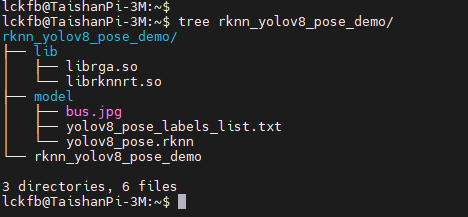
最终生成 install/ 文件目录如下:
(base) lipeng@host:~/workspace/yolo11/rknn_model_zoo$ tree install
install
`-- rk3576_linux_aarch64
    |-- rknn_yolov8_pose_demo
    |   |-- lib
    |   |   |-- librga.so
    |   |   `-- librknnrt.so
    |   |-- model
    |   |   |-- bus.jpg
    |   |   |-- yolov8_pose.rknn
    |   |   `-- yolov8_pose_labels_list.txt
    |   `-- rknn_yolov8_pose_demo
板端Demo演示
转移文件
接下来我们需要将 rknn_model_zoo/install/rk3576_linux_aarch64/rknn_yolov8_pose_demo 目录转移到到板子上面:
推荐使用
adb工具,进行转移,泰山派3m默认开启ADB,或者使用TF卡,ssh或者U盘都可以。参考:https://wiki.lckfb.com/zh-hans/tspi-3-rk3576/system-usage/debian12-usage/adb-usage.html
adb push yolo11/rknn_model_zoo/install/rk3576_linux_aarch64/rknn_yolov8_pose_demo /home/lckfb/
板端运行
详细请阅读:https://github.com/airockchip/rknn_model_zoo/blob/main/examples/yolo11/README.md
我们进入泰山派开发板的终端,然后进入 rknn_yolov8_pose_demo/ 目录:
# 进入目录
cd rknn_yolov8_pose_demo/
设置动态库路径:(为当前目录下的 ./lib 目录下 )

# 设置动态库路径 (非常重要,否则会报错误)
export LD_LIBRARY_PATH=./lib
赋予demo可执行权限
sudo chmod +x rknn_yolov8_pose_demo
运行Demo:
# 命令格式:./rknn_yolov8_pose_demo <RKNN模型路径> <传入的图片路径>
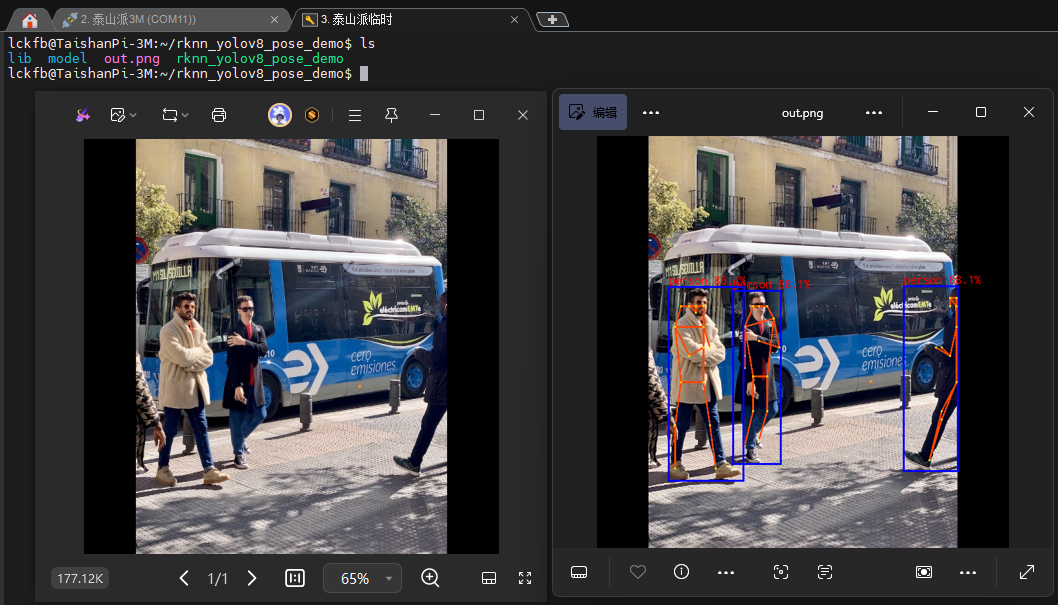
sudo ./rknn_yolov8_pose_demo model/yolov8_pose.rknn model/bus.jpg
最终会生成一个
out.png图片,保存有最终识别之后的成果。

汇聚全球AI编程工具,助力开发者即刻编程。
更多推荐



 8
8 0
0- 0


 已为社区贡献6条内容

所有评论(0)