
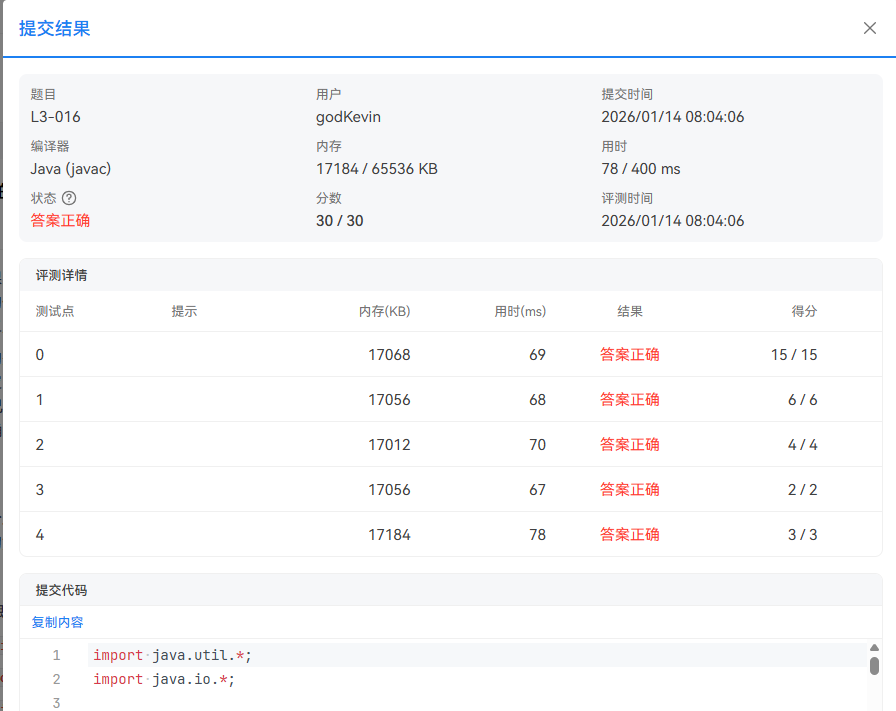
PTA 团体程序设计天梯赛 L3-016 二叉搜索树的结构 (Java)(满分不超时)
·
二叉搜索树或者是一棵空树,或者是具有下列性质的二叉树: 若它的左子树不空,则左子树上所有结点的值均小于它的根结点的值;若它的右子树不空,则右子树上所有结点的值均大于它的根结点的值;它的左、右子树也分别为二叉搜索树。(摘自百度百科)
给定一系列互不相等的整数,将它们顺次插入一棵初始为空的二叉搜索树,然后对结果树的结构进行描述。你需要能判断给定的描述是否正确。例如将{ 2 4 1 3 0 }插入后,得到一棵二叉搜索树,则陈述句如“2是树的根”、“1和4是兄弟结点”、“3和0在同一层上”(指自顶向下的深度相同)、“2是4的双亲结点”、“3是4的左孩子”都是正确的;而“4是2的左孩子”、“1和3是兄弟结点”都是不正确的。
输入格式:
输入在第一行给出一个正整数N(≤100),随后一行给出N个互不相同的整数,数字间以空格分隔,要求将之顺次插入一棵初始为空的二叉搜索树。之后给出一个正整数M(≤100),随后M行,每行给出一句待判断的陈述句。陈述句有以下6种:
A is the root,即"A是树的根";A and B are siblings,即"A和B是兄弟结点";A is the parent of B,即"A是B的双亲结点";A is the left child of B,即"A是B的左孩子";A is the right child of B,即"A是B的右孩子";A and B are on the same level,即"A和B在同一层上"。
题目保证所有给定的整数都在整型范围内。
输出格式:
对每句陈述,如果正确则输出Yes,否则输出No,每句占一行。
输入样例:
5
2 4 1 3 0
8
2 is the root
1 and 4 are siblings
3 and 0 are on the same level
2 is the parent of 4
3 is the left child of 4
1 is the right child of 2
4 and 0 are on the same level
100 is the right child of 3
输出样例:
Yes
Yes
Yes
Yes
Yes
No
No
No
代码长度限制
16 KB
时间限制
400 ms
内存限制
64 MB
栈限制
8192 KB
Java实现:
/**
 * 逻辑大概是这样的:
 * 1. 搞个树:按照题目给的顺序一个一个往里塞,做成标准的二叉搜索树。塞的时候顺便记下每个人的父节点是谁,在哪一层。
 * 2. 存个表:用个 HashMap 把值和节点对应起来,这样待会儿查某个数字的信息,直接搜一下就行,不用满树跑。
 * 3. 读句子:句子虽然长,但关键点就那么几个词。看句子里有没有 "root"、"parent" 之类的关键词,
 * 顺便把句子里的数字抠出来。
 * 4. 给答案:拿到数字去表里查,看看是不是 root,或者是不是同一个父节点,位置对不对,最后回个 Yes 或 No。
 */

import java.util.*;
import java.io.*;

public class Main {
    // 节点类,存值、父节点、左右孩子和深度
    static class Node {
        int val, depth;
        Node left, right, parent;
        Node(int val, int depth, Node parent) {
            this.val = val;
            this.depth = depth;
            this.parent = parent;
        }
    }

    // map 用来快速定位节点,不用每次都去遍历树
    static Map<Integer, Node> map = new HashMap<>();
    static Node root = null;

    public static void main(String[] args) throws IOException {
        FastReader fr = new FastReader(System.in);
        PrintWriter out = new PrintWriter(new BufferedWriter(new OutputStreamWriter(System.out)));

        // 1. 读入 N 个数开始搭树
        int N = fr.nextInt();
        for (int i = 0; i < N; i++) {
            root = insert(root, fr.nextInt(), 0, null);
        }

        // 2. 读入 M 个查询
        int M = fr.nextInt();
        for (int i = 0; i < M; i++) {
            String line = fr.nextLine();
            // 判断 solve 给的结果,Yes 或者 No
            if (line != null && solve(line)) out.println("Yes");
            else out.println("No");
        }
        out.flush();
        out.close();
    }

    // 标准的 BST 插入,小的往左走,大的往右走
    static Node insert(Node node, int val, int depth, Node parent) {
        if (node == null) {
            Node newNode = new Node(val, depth, parent);
            map.put(val, newNode); // 塞进 map 方便待会儿搜
            return newNode;
        }
        if (val < node.val) node.left = insert(node.left, val, depth + 1, node);
        else node.right = insert(node.right, val, depth + 1, node);
        return node;
    }


    // 解析句子的逻辑
    static boolean solve(String line) {
        String[] words = line.split(" ");
        try {
            // A 是不是根节点
            if (line.endsWith("root")) {
                int a = Integer.parseInt(words[0]);
                return map.containsKey(a) && map.get(a) == root;
            }

            // A 和 B 是不是亲兄弟(同一个父亲)
            if (line.contains("siblings")) {
                int a = Integer.parseInt(words[0]);
                int b = Integer.parseInt(words[2]);
                if (!map.containsKey(a) || !map.containsKey(b)) return false;
                Node na = map.get(a), nb = map.get(b);
                return na.parent != null && nb.parent != null && na.parent == nb.parent;
            }

            // A 是不是 B 的父亲
            if (line.contains("parent")) {
                int a = Integer.parseInt(words[0]);
                int b = Integer.parseInt(words[words.length - 1]);
                if (!map.containsKey(a) || !map.containsKey(b)) return false;
                return map.get(b).parent == map.get(a);
            }

            // A 是不是 B 的左儿子
            if (line.contains("left child")) {
                int a = Integer.parseInt(words[0]);
                int b = Integer.parseInt(words[words.length - 1]);
                if (!map.containsKey(a) || !map.containsKey(b)) return false;
                return map.get(b).left == map.get(a);
            }

            // A 是不是 B 的右儿子
            if (line.contains("right child")) {
                int a = Integer.parseInt(words[0]);
                int b = Integer.parseInt(words[words.length - 1]);
                if (!map.containsKey(a) || !map.containsKey(b)) return false;
                return map.get(b).right == map.get(a);
            }

            // A 和 B 是不是在同一层(深度一样)
            if (line.contains("same level")) {
                int a = Integer.parseInt(words[0]);
                int b = Integer.parseInt(words[2]);
                if (!map.containsKey(a) || !map.containsKey(b)) return false;
                return map.get(a).depth == map.get(b).depth;
            }
        } catch (Exception e) {
            return false;
        }
        return false;
    }

    // 这一堆是用来加速读数据的,比普通的快不少
    static class FastReader {
        BufferedReader br;
        StringTokenizer st;

        public FastReader(InputStream is) {
            br = new BufferedReader(new InputStreamReader(is));
        }

        String next() {
            while (st == null || !st.hasMoreElements()) {
                try {
                    String s = br.readLine();
                    if (s == null) return null;
                    st = new StringTokenizer(s);
                } catch (IOException e) {
                    return null;
                }
            }
            return st.nextToken();
        }

        int nextInt() {
            return Integer.parseInt(next());
        }

        String nextLine() {
            try {
                return br.readLine();
            } catch (IOException e) {
                return null;
            }
        }
    }
}

汇聚全球AI编程工具,助力开发者即刻编程。
更多推荐
 2
2 0
0- 0


 已为社区贡献13条内容

所有评论(0)