
2025-11-21 XQQ NOIP Round 1 hetao1733837的record
2025-11-21 XQQ NOIP Round 1 hetao1733837的record
A.tree
提交链接:树
题面
题目描述
给定一棵 n n n 个点的树和一个长度为 n n n 的数组 s c o r e [ 0 ] , . . . , s c o r e [ n − 1 ] score[0], ..., score[n-1] score[0],...,score[n−1]。
你觉得这棵树不是很好看,所以你准备修一修这棵树,具体的说,你可以执行若干次以下操作:
- 选择任意一条边并删除,在产生的两个连通块保留一个并删除一个。
定义最后剩下的连通块 S S S 的价值为 ∑ u ∈ S s c o r e [ d e g u ] \sum_{u \in S} score[deg_u] ∑u∈Sscore[degu] 其中 d e g u deg_u degu 表示点 u u u 的度数,你想要最大化这个价值,输出这个值。
输入格式
第一行一个正整数 n n n,表示节点个数。
第二行 n n n 个整数 s c o r e [ 0 ] , s c o r e [ 1 ] , . . . , s c o r e [ n − 1 ] score[0], score[1], ..., score[n-1] score[0],score[1],...,score[n−1]。
接下来 n − 1 n-1 n−1 行每行两个正整数 x , y x, y x,y,表示树上的一条无向边。
输出格式
一行一个整数表示答案。
4
10 1 2 3
1 2
1 3
2 4
10
5
0 1 5 1 1
1 2
1 3
1 4
1 5
7
5
-5 -1 1 1 1
1 2
1 3
3 4
3 5
0
数据范围
- 对于 20% 的数据 n ≤ 20 n \leq 20 n≤20.
- 对于 40% 的数据 n ≤ 3000 n \leq 3000 n≤3000.
- 对于 另外 20% 的数据, 树的形态是一条链.
- 对于 100% 的数据, 2 ≤ n ≤ 200000 2 \leq n \leq 200000 2≤n≤200000, ∣ s c o r e [ i ] ∣ ≤ 1 0 9 |score[i]| \leq 10^9 ∣score[i]∣≤109
分析
显然,我们在场上注意到了一颗树(包含子树),删去一条边,会变成一颗子树+啊吧啊吧状物。由于多次修改,无法贪心 ,考虑树上 D P DP DP。
设 f i f_i fi表示 i i i选择 i i i这个子树里的一些点,同时钦定选 i i i以及 i i i与父亲节点连边的最大的分,则每次转移时一定会选择所有儿子中最大的几个 f u f_u fu。
于是对于一个点 i i i直接将他所有的儿子的 f v f_v fv从大到小排序,然后更新 f i f_i fi即可。
f i = max ( s u m f k + s c o r e k + 1 ) f_i=\max(sum\ f_k+score_{k+1}) fi=max(sum fk+scorek+1)
正解
#include <bits/stdc++.h>
#define int long long
using namespace std;
const int N = 200005;
int n, score[N], f[N];
vector<int> e[N];
int ans = 0xc0c0c0c0c0c0c0c0;
void dfs(int u, int fa){
	f[u] = 0xc0c0c0c0c0c0c0c0;
	deque<int> son;
	for (auto v : e[u]){
		if (v == fa)
			continue;
		dfs(v, u);
		son.push_back(f[v]);
	}
	sort(son.begin(), son.end(), greater<int>());
	for (int i = 1; i < son.size(); i++)
		son[i] += son[i - 1];
	son.push_front(0);
	for (int i = 0; i < son.size(); i++){
		ans = max(ans, son[i] + score[i]);
	}
	if (fa){
		for (int i = 0; i < son.size(); i++){
			f[u] = max(f[u], son[i] + score[i + 1]);
		}
	}
}
signed main(){
	freopen("tree.in", "r", stdin);
	freopen("tree.out", "w", stdout);
	ios::sync_with_stdio(0);
	cin.tie(0);
	cout.tie(0);
	cin >> n;
	for (int i = 0; i < n; i++){
		cin >> score[i];
	}
	for (int i = 1; i < n; i++){
		int x, y;
		cin >> x >> y;
		e[x].push_back(y);
		e[y].push_back(x);
	}
	dfs(1, 0);
	cout << ans;
}
B.card
提交链接:牌
题面
题目描述
有 n n n 张牌,第 i i i 张牌正面写着 a i a_i ai,反面写着 b i b_i bi。从这 n n n 张牌中选出若干张,使得他们正面的数的异或和乘以反面的数的异或和的结果最大。牌不能翻面。
输入格式
第一行一个正整数 T T T, 表示测试数据组数。
每组测试数据第一行一个正整数 n n n。
第二行 n n n 个正整数 a i a_i ai。
第三行 n n n 个正整数 b i b_i bi。
输出格式
每组数据输出一行一个整数, 表示答案。
1
6
1 1 4 5 1 4
19 1 9 8 1 0
130
2
2
1 2
2 1
5
1 2 3 4 5
5 4 5 3 5
9
42
数据范围
- 对于 15% 的数据 n ≤ 20 n \leq 20 n≤20
- 对于 30% 的数据 n ≤ 2000 , a i , b i < 2 10 n \leq 2000, a_i, b_i < 2^{10} n≤2000,ai,bi<210
- 对于 60% 的数据, a i , b i < 2 10 a_i, b_i < 2^{10} ai,bi<210
- 对于另外 10% 的数据 a i < 2 a_i < 2 ai<2.
- 对于 100% 的数据, 1 ≤ n ≤ 1 0 5 , 0 ≤ a i , b i < 2 20 , T ≤ 5 1 \leq n \leq 10^5, 0 \leq a_i, b_i < 2^{20}, T \leq 5 1≤n≤105,0≤ai,bi<220,T≤5
分析
难道贪心的选择使得每一个二进制位都有奇数次重合?一看线性基,小蛐蛐,我***!好的,我们拿一下部分分——爆搜!
15pts
#include <bits/stdc++.h>
#define int long long
using namespace std;
const int N = 100005;
int a[N], b[N], n;
int ans = 0xc0c0c0c0;
void dfs(int p, int z, int f){
    if (p > n){
        ans = max(ans, z * f);
        return ;
    }
    dfs(p + 1, z, f);
    dfs(p + 1, z ^ a[p], f ^ b[p]);
}
signed main(){
    freopen("card.in", "r", stdin);
    freopen("card.out", "w", stdout);
    int T;
    cin >> T;
    while (T--){
        cin >> n;
        for (int i = 1; i <= n; i++)
            cin >> a[i];
        for (int i = 1; i <= n; i++)
            cin >> b[i];
        ans = 0;
        dfs(0, 0, 0);
        cout << ans << '\n';
    }
}
看看满分做法能不能看懂吧……
呃……线性基是个……呃……通俗来说,就是用基底表示 n n n维空间的东西……mhh认为应该是对的。
这题有异或相关,所以,自然而然地想到线性基(线性基用于维护异或相关……)。
好的,那么,我编不下去了,直接把题解拿下来。
发现值域不大,我们对于所有 a i a_i ai建立一个线性基,在建立的时候,如果一个 a i a_i ai成功被插入到了这个线性基中,我们记录此时对应的 b i b_i bi。否则,如果 a i a_i ai可以通过线性基里已有的若干个数异或起来表示,同时,也满足 a i a_i ai与这些数异或起来等于 0 0 0,把此时 b i b_i bi还剩下的值 b ′ b' b′(在 a i a_i ai插入过程中, a i a_i ai会在线性基中疯狂异或,同时 b i b_i bi也会疯狂异或记录的 b b b,最后会剩下一个 b ′ b' b′)插入到另一个线性基中。
插入完成,我们枚举选出若干个牌之后正面的异或值 X X X,然后判断 X X X是否能被 若干个 a i a_i ai合并,若能,此时会有一个对应的反面的异或和 Y Y Y,是一组合法的特解。但是 Y Y Y不一定是最大的,枚举第二个线性基 ,查询 Y Y Y异或上若干个 b ′ b' b′的最大值。
复杂度 O ( ( n + V ) l o g V ) O((n+V)logV) O((n+V)logV)
正解
#include <bits/stdc++.h>
#define int long long
using namespace std;
const int N = 100005, D = 40;
int n, a[N], b[N];
int T;
struct _bas1{
	int p[D], q[D];
	int insert(int u, int v){
		for (int i = 20; i >= 0; i--){
			if ((u >> i) & 1){
				if (p[i]){
					u ^= p[i];
					v ^= q[i];
				}
				else{
					p[i] = u;
					q[i] = v;
					return 0;
				}
			}
		}
		return v;
	}
	int query(int x){
		int res = 0;
		for (int i = 20; i >= 0; i--){
			if ((x >> i) & 1){
				if (!p[i])
					return -1;
				x ^= p[i];
				res ^= q[i];
			}
		}
		return res;
	}
	void clear(){
		fill(p, p + D, 0ll);
		fill(q, q + D, 0ll);
	}
}b1;
struct _bas2{
	int p[D];
	void insert(int x){
		for (int i = 20; i >= 0; i--){
			if ((x >> i) & 1){
				if (p[i]){
					x ^= p[i];
				}
				else{
					return p[i] = x, void();
				}
			}
			if (!x)
				return ;
		}
	}
	int querymx(int x){
		for (int i = 20; i >= 0; i--){
			if ((x ^ p[i]) >= x){
				x ^= p[i];
			}
		}
		return x;
	}
	void clear(){
		fill(p, p + D, 0ll);
	}
}b2;
signed main(){
	ios::sync_with_stdio(0);
	cin.tie(0);
	cout.tie(0);
	freopen("card.in", "r", stdin);
	freopen("card.out", "w", stdout);
	cin >> T;
	while (T--){
		b1.clear();
		b2.clear();
		cin >> n;
		for (int i = 1; i <= n; i++)
			cin >> a[i];
		for (int i = 1; i <= n; i++)
			cin >> b[i];
		for (int i = 1; i <= n; i++){
			int res = b1.insert(a[i], b[i]);
			if (res)
				b2.insert(res);
		}
		int ans = 0;
		for (int i = 0; i < (1ll << 20); i++){
			int res = b1.query(i);
			if (res == -1)
				continue;
			ans = max(ans, b2.querymx(res) * i);
		}
		cout << ans << '\n';
	}
}
C.coin
提交链接:币
题面
题目描述
小 D 非常无聊,所以他开始记录自己掷硬币的结果。
如果硬币的正面朝上就在纸上写下一个 1 1 1,反面朝上就写下一个 0 0 0,将写下的数看成一个字符串,如果这个 01 01 01 字符串的末尾 n n n 个字符组成的子串正好是 S 1 S_1 S1,那么小 D D D 就会停下。
我们认为掷硬币的结果是一个独立的随机事件,正面朝上和反面朝上概率均为 1 / 2 1/2 1/2。
现在小 D D D 已经投掷了 m m m 次硬币,并以字符串的形式给出了这 m m m 次投掷的结果 S 2 S_2 S2,你想要知道,他期望再投掷多少次会停下。
为了避免精度误差,你只需要输出答案对 1 0 9 + 7 10^9 + 7 109+7 取模的结果。
注意,如果在前 m m m 次投掷的某次末尾的 n n n 个字符已经组成 S 1 S_1 S1,那么你应该输出 0 0 0。
输入格式
第一行一个正整数 T T T,表示测试数据组数。
每组测试数据包含两行,第一行一个整数 n n n 和一个字符串 S 1 ′ S_1' S1′。
第二行一个整数 m m m 和一个字符串 S 2 ′ S_2' S2′
原始的 S 1 S_1 S1 和 S 2 S_2 S2 需要从 S 1 ′ S_1' S1′ 和 S 2 ′ S_2' S2′ 解出。
加密串包含 ‘a’-‘z’(分别代表 0 - 25),和 ‘A’-‘F’(分别代表 26 - 31),将加密串的每个字符替换成对应数组的五位二进制数,比如 “An” 替换之后为 “1101001101”。替换之后取前 n n n ( m m m)个字符作为原始的 S 1 S_1 S1 ( S 2 S_2 S2).
输出格式
对于每组数据,输出一行一个整数,表示答案。
3
1 a
0 a
3 a
2 a
8 An
3 B
2
8
254
3
10 rayisgay
13 gayisray
20 asdfjissjs
13 difisjfsdd
12 fdddddfdf
13 ddodododo
1020
1048512
4102
数据范围与提示
- 对于 20% 的数据 n ≤ 3 n \le 3 n≤3
- 对于 30% 的数据, n ≤ 10 n \le 10 n≤10
- 对于 50% 的数据, n ≤ 100 n \le 100 n≤100
- 对于 70% 的数据, n ≤ 2000 n \le 2000 n≤2000
- 对于 90% 的数据, n ≤ 1 0 5 n \le 10^5 n≤105
- 对于 100% 的数据, T ≤ 10 , 1 ≤ ∣ S 1 ′ ∣ , ∣ S 2 ′ ∣ ≤ 200000 , 1 ≤ n ≤ 5 × ∣ S 1 ′ ∣ , 0 ≤ m ≤ 5 × ∣ S 2 ′ ∣ , 1 ≤ ∑ ∣ S 1 ′ ∣ , ∑ ∣ S 2 ′ ∣ ≤ 1 0 6 T \le 10, 1 \le |S_1'|, |S_2'| \le 200000, 1 \le n \le 5 \times |S_1'|, 0 \le m \le 5 \times |S_2'|, 1 \le \sum |S_1'|, \sum |S_2'| \le 10^6 T≤10,1≤∣S1′∣,∣S2′∣≤200000,1≤n≤5×∣S1′∣,0≤m≤5×∣S2′∣,1≤∑∣S1′∣,∑∣S2′∣≤106
分析
法一
猜到的 K M P KMP KMP。艹,你们AC自动机考爽了?还在出?尝试一下。匹配完成了 j j j个字符,要匹配第 j + 1 j+1 j+1个字符时有两种情况:
s j + 1 = t i s_{j+1}=t_i sj+1=ti,状态从 j → j + 1 j\rightarrow j+1 j→j+1转移
s j + 1 ≠ t i s_{j+1}\neq t_i sj+1=ti,状态从 j → f a i l j j\rightarrow fail_j j→failj
这个题上,我们每次概率生成 0 0 0或 1 1 1,然后:
如果这次生成的和之前生成的一样,那么状态从 i → i + 1 i \rightarrow i+1 i→i+1,否则,状态 i → f a i l i i \rightarrow fail_i i→faili
设 f i f_i fi表示要走到 i + 1 i+1 i+1得到期望步数 ,有:
f i = 1 + 1 2 ∑ j = f a i l i i f j f_i=1+\frac{1}{2}\sum\limits_{j=fail_i}^{i}f_j fi=1+21j=faili∑ifj
将 右侧的 f i f_i fi移到左侧 ,前缀和优化转移即可。
正解
#include <bits/stdc++.h>
#define int long long
#define rep(i, a, b) for (int i = (a); i <= (b); i++)
using namespace std;
const int N = 1000005, mod = 1e9 + 7, inv2 = (mod + 1) / 2;
int fplus(int x, int y) { return x + y >= mod ? x + y - mod : x + y; }
void Fplus(int &x, int y) { x = fplus(x, y); }
int fminus(int x, int y) { return x - y < 0 ? x + mod - y : x - y; }
void Fminus(int &x, int y) { x = fminus(x, y); }
int n, m, s[N], t[N], nxt[N], tr[N][2], f[N];
char ch[N];
void input(int *a) {
    scanf("%s", ch);
    int len = strlen(ch);
    rep(i, 0, len - 1) {
        int c = ch[i] >= 'a' && ch[i] <= 'z' ? ch[i] - 'a' : ch[i] - 'A' + 26;
        rep(j, 1, 5) a[i * 5 + j] = c >> (5 - j) & 1;
    }
}
bool Med;
int read() {
    int x = 0, f = 1;
    char c = getchar();
    while (c < '0' || c > '9') {
        if (c == '-')
            f = -1;
        c = getchar();
    }
    while (c >= '0' && c <= '9') {
        x = x * 10 + (c - '0');
        c = getchar();
    }
    return x * f;
}
signed main() {
    freopen("coin.in", "r", stdin);
    freopen("coin.out", "w", stdout);
    fprintf(stderr, "%3lfMb\n", (&Med - &Med) / 1024. / 1024.);
    for (int T = read(); T--;) {
        n = read(), input(s);
        m = read(), input(t);
        for (int i = 2, j = 0; i <= n; i++) {
            while (j && s[j + 1] != s[i])
                j = nxt[j];
            nxt[i] = j += s[j + 1] == s[i];
        }
        rep(i, 0, n - 1) {
            rep(j, 0, 1) {
                if (s[i + 1] == j)
                    tr[i][j] = i + 1;
                else
                    tr[i][j] = i ? tr[nxt[i]][j] : 0;
            }
        }
        int cur = 0;
        rep(i, 1, m) {
            cur = tr[cur][t[i]];
            if (cur == n)
                break;
        }
        if (cur == n) {
            printf("0\n");
            continue;
        }
        f[0] = 2;
        rep(i, 1, n - 1) {
            int j = tr[i][0] ^ tr[i][1] ^ (i + 1);
            f[i] = fplus(2, fminus(f[i - 1], j ? f[j - 1] : 0));
            Fplus(f[i], f[i - 1]);
        }
        printf("%d\n", fminus(f[n - 1], cur ? f[cur - 1] : 0));
    }
    return 0;
}
何意味啊,我们看法二。
法二
期望是 ∑ i ∈ b o r d e r ( S ) 2 i \sum\limits_{i\in border(S)}2^i i∈border(S)∑2i。设 f i f_i fi表示生成前 i i i个字符所需要的期望次数,有:
f i = ∑ j ∈ b o r d e r ( S ) 2 j = f f a i l ( i ) + 2 i f_i=\sum\limits_{j\in border(S)}2^j=f_{fail(i)}+2^i fi=j∈border(S)∑2j=ffail(i)+2i
由于期望线性性,最终答案 f n − f e x f_n-f_{ex} fn−fex, e x ex ex是 s 2 s2 s2最长后缀满足是 s 1 s1 s1的前缀。
代码
#include <bits/stdc++.h>
using namespace std;

// Options Start

// #define NETWORK_FLOW
// #define SEGMENT_TREE
#define FILE_IO
#define MULTI_TESTS

// Options End
#ifdef LOCAL_TEST
bool __mem_begin;
#endif
#define int long long
#define mid ((l + r) >> 1)
#ifndef LOCAL_TEST
#define endl '\n'
#endif
#ifdef SEGMENT_TREE
#define lson (p << 1)
#define rson (p << 1 | 1)
#endif
#ifdef NETWORK_FLOW
#define rev(p) (p ^ 1)
#endif

const int mod = 1e9 + 7;

int quickpow(int a, int b) {
	int ret = 1;
	while (b) {
		if (b & 1) ret = ret * a % mod;
		a = a * a % mod; b >>= 1;
	}
	return ret;
}


void work() {
	string s1, s2;
	int n, m;
	cin >> n >> s1;
	cin >> m >> s2;
	vector<int> a, b;
	a.push_back(-1);
	for (int i = 0; i < (int)s1.size(); ++i) {
		int x = 0;
		if (islower(s1[i])) x = s1[i] - 'a';
		else x = s1[i] - 'A' + 26;
		for (int j = 4; j >= 0; --j) {
			if (x >> j & 1) a.push_back(1);
			else a.push_back(0);
		}
	}
	a.erase(a.begin() + n + 1, a.end());
	b.push_back(-1);
	for (int i = 0; i < (int)s2.size(); ++i) {
		int x = 0;
		if (islower(s2[i])) x = s2[i] - 'a';
		else x = s2[i] - 'A' + 26;
		for (int j = 4; j >= 0; --j) {
			if (x >> j & 1) b.push_back(1);
			else b.push_back(0);
		}
	}
	b.erase(b.begin() + m + 1, b.end());

	// cout << "a=" << a.size() << endl;
	// for (auto x:a)
	// 	cout << x << ' ';
	// cout << endl;
	// cout << "b=" << b.size() << endl;
	// for (auto x:b)
	// 	cout << x << ' ';
	// cout << endl;

	vector<int> fail(n + 1), f(n + 1);
	int j = 0;
	for (int i = 2; i <= n; ++i) {
		while (j && a[j + 1] != a[i]) j = fail[j];
		if (a[j + 1] == a[i]) j++;
		fail[i] = j;
	}
	j = 0;
	for (int i = 1; i <= m; ++i) {
		while (j && a[j + 1] != b[i]) j = fail[j];
		if (a[j + 1] == b[i]) ++j;
		if (j >= n) return cout << 0 << endl, void();
	}
	// cout << "f=" << endl;
	for (int i = 1; i <= n; ++i) {
		f[i] = (f[fail[i]] + quickpow(2, i)) % mod;
		// cout << f[i] << ' ';
	}
	// cout << endl;
	vector<int> c, failc;
	c.push_back(-1);
	c.insert(c.end(), a.begin() + 1, a.end());
	c.push_back('#');
	c.insert(c.end(), b.begin() + 1, b.end());
	failc.resize(c.size());
	j = 0;
	for (int i = 2; i < (int)c.size(); ++i) {
		while (j && c[j + 1] != c[i]) j = failc[j];
		if (c[j + 1] == c[i]) j++;
		failc[i] = j;
	}
	int ex = failc.back();
	ex = min(ex, n);
	// cout << "ex=" << ex << endl;
	cout << (f[n] - f[ex] + mod) % mod << endl;
}

#ifdef LOCAL_TEST
bool __mem_end;
#endif

signed main(void) {
#ifdef FILE_IO
#ifndef LOCAL_TEST
	freopen("coin.in", "r", stdin);
	freopen("coin.out", "w", stdout);
#endif
#endif
	ios::sync_with_stdio(false); cin.tie(NULL);
	srand(time(nullptr));
#ifdef MULTI_TESTS
	int T = 1; cin >> T; T--;
	while (T--) work();
#endif
	work();
	return 0;
}
D.hole
原题链接:洞
分析
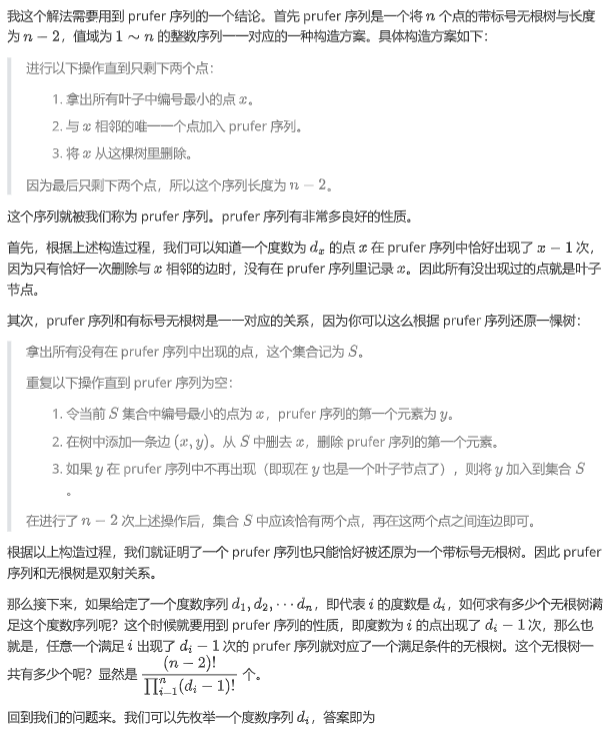
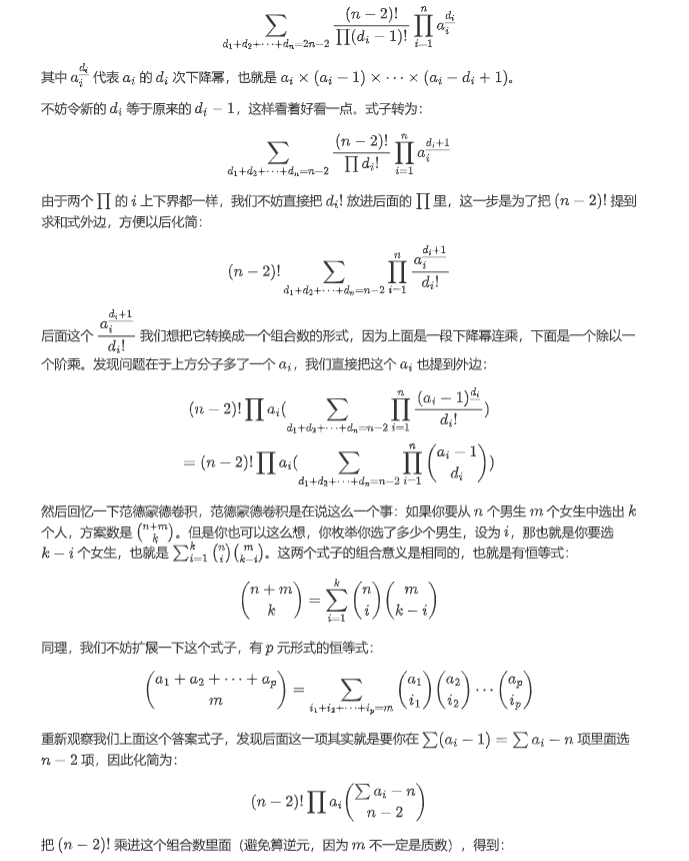
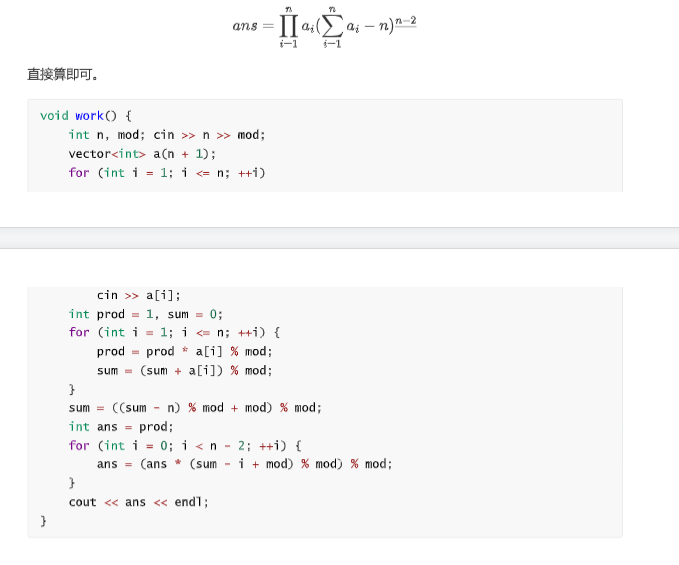

汇聚全球AI编程工具,助力开发者即刻编程。
更多推荐
 21
21 0
0- 0


 已为社区贡献4条内容

所有评论(0)