
2026年李宏毅机器学习-homework1(新冠预测)
h1,对美国各州进行one-hot编码,选用MSE(Mean Square error)
任务描述:根据美国某州过去5天的调查/检测结果,预测第5天新增检测阳性病例的百分比。
训练集:
118列=id(1)+州(37)+新冠症状、行为表现、心理健康情况、每天的感染概率(16*5)
测试集:
117列,少了第五天的感染概率
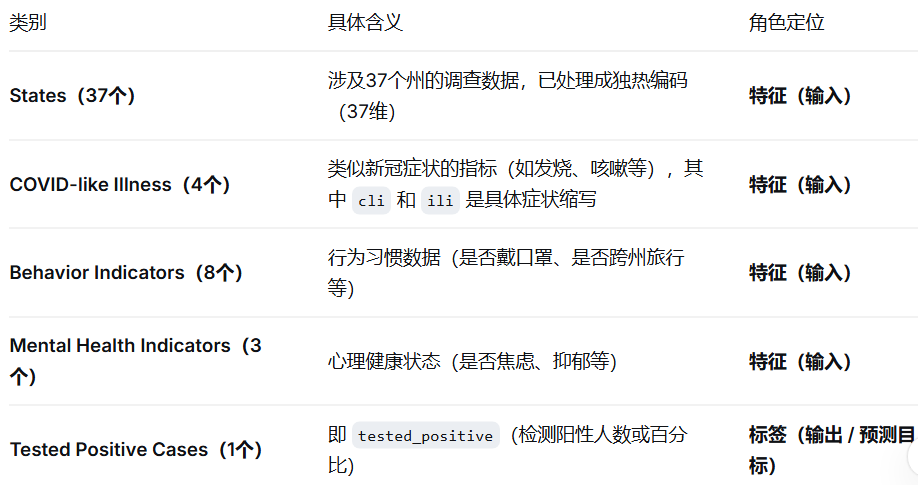
作业h1: COVID-19 事件预测 (回归)
学习目标:
- 使用 deep neural networks (DNN)解决回归问题
- 理解基本的DNN训练技巧
- 熟悉和掌握PyTorch.
下载数据集:
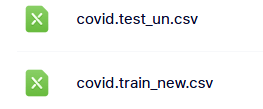
下载 Google Drive 上 ID 为 1kLSW_-cW2Huj7bh84YTdimGBOJaODiOS 的文件,并保存为 covid.train.csv(训练集)。下载 ID 为 1iiI5qROrAhZn-o4FPqsE97bMzDEFvIdg 的文件,并保存为 covid.test.csv(测试集)。
!gdown --id '1kLSW_-cW2Huj7bh84YTdimGBOJaODiOS' --output covid.train.csv
!gdown --id '1iiI5qROrAhZn-o4FPqsE97bMzDEFvIdg' --output covid.test.csv
调包:
# Numerical Operations
import math
import numpy as np

# Reading/Writing Data
import pandas as pd
import os
import csv

# For Progress Bar 进度条
from tqdm import tqdm

# Pytorch
import torch
import torch.nn as nn
from torch.utils.data import Dataset, DataLoader, random_split

# For plotting learning curve
from torch.utils.tensorboard import SummaryWriter
Some Utility Functions
你不需要调整这一部分
cudnncuDNN 是 NVIDIA 提供的深度学习加速库,PyTorch 在使用 GPU 训练卷积神经网络时,经常会调用它。determinsitic=True,就是尽量使用“确定性算法”
benchmark 默认True情况下,使用速度最快的算法,但会影响结果的稳定性。
def same_seed(seed):
让 GPU 计算尽量稳定
关闭 GPU 自动选择最快算法
固定 NumPy 的随机种子
固定 PyTorch CPU 的随机种子
如果有 GPU,也固定 PyTorch GPU 的随机数
def same_seed(seed):
    '''Fixes random number generator seeds for reproducibility.
       固定随机种子'''
    torch.backends.cudnn.deterministic = True
    torch.backends.cudnn.benchmark = False
    np.random.seed(seed)
    torch.manual_seed(seed)
    if torch.cuda.is_available():
        torch.cuda.manual_seed_all(seed)

def train_valid_split(data_set, valid_ratio, seed):
    '''Split provided training data into training set and validation set
       在已有训练集上再划分成训练集和验证集'''
    valid_set_size = int(valid_ratio * len(data_set))
    train_set_size = len(data_set) - valid_set_size
    train_set, valid_set = random_split(data_set, [train_set_size, valid_set_size], generator=torch.Generator().manual_seed(seed))
    return np.array(train_set), np.array( valid_set)

def predict(test_loader, model, device):
 ''' Set your model to evaluation mode.预测函数模块'''
    model.eval()
    for x in tqdm(test_loader):
        x = x.to(device)
        with torch.no_grad():
            pred = model(x)
            preds.append(pred.detach().cpu())
    preds = torch.cat(preds, dim=0).numpy()
    return preds
Dataset数据集
class COVID19Dataset(Dataset):
    '''
    x: Features.
    y: Targets, if none, do prediction.
    '''
    def __init__(self, x, y=None):
        if y is None:
            self.y = y
        else:
            self.y = torch.FloatTensor(y)
        self.x = torch.FloatTensor(x)

    def __getitem__(self, idx):
        if self.y is None:
            return self.x[idx]
        else:
            return self.x[idx], self.y[idx]

    def __len__(self):
        return len(self.x)
Neural Network Model 神经网络模型
通过修改下面的类来尝试不同的模型架构。
class My_Model(nn.Module):
    def __init__(self, input_dim):
        super(My_Model, self).__init__()
        # TODO: modify model's structure, be aware of dimensions.
        self.layers = nn.Sequential(
            nn.Linear(input_dim, 16),
            nn.ReLU(),
            nn.Linear(16, 8),
            nn.ReLU(),
            nn.Linear(8, 1)
        )

    def forward(self, x):
        x = self.layers(x)
        x = x.squeeze(1) # (B, 1) -> (B)
        return x
Feature Selection 特征选取
通过修改下面的函数来选择你认为有用的特征
def select_feat(train_data, valid_data, test_data, select_all=True):
    '''Selects useful features to perform regression'''
    y_train, y_valid = train_data[:,-1], valid_data[:,-1]
    raw_x_train, raw_x_valid, raw_x_test = train_data[:,:-1], valid_data[:,:-1], test_data

    if select_all:
        feat_idx = list(range(raw_x_train.shape[1]))
    else:
        feat_idx = [0,1,2,3,4] # TODO: Select suitable feature columns.

    return raw_x_train[:,feat_idx], raw_x_valid[:,feat_idx], raw_x_test[:,feat_idx], y_train, y_valid
Training Loop
def trainer(train_loader, valid_loader, model, config, device):

    criterion = nn.MSELoss(reduction='mean') # Define your loss function, do not modify this.

    # Define your optimization algorithm.
    # TODO: Please check https://pytorch.org/docs/stable/optim.html to get more available algorithms.
    # TODO: L2 regularization (optimizer(weight decay...) or implement by your self).
    optimizer = torch.optim.SGD(model.parameters(), lr=config['learning_rate'], momentum=0.9)

    writer = SummaryWriter() # Writer of tensoboard.

    if not os.path.isdir('./models'):
        os.mkdir('./models') # Create directory of saving models.

    n_epochs, best_loss, step, early_stop_count = config['n_epochs'], math.inf, 0, 0

    for epoch in range(n_epochs):
        model.train() # Set your model to train mode.
        loss_record = []

        # tqdm is a package to visualize your training progress.
        train_pbar = tqdm(train_loader, position=0, leave=True)

        for x, y in train_pbar:
            optimizer.zero_grad()               # Set gradient to zero.
            x, y = x.to(device), y.to(device)   # Move your data to device.
            pred = model(x)
            loss = criterion(pred, y)
            loss.backward()                     # Compute gradient(backpropagation).
            optimizer.step()                    # Update parameters.
            step += 1
            loss_record.append(loss.detach().item())

            # Display current epoch number and loss on tqdm progress bar.
            train_pbar.set_description(f'Epoch [{epoch+1}/{n_epochs}]')
            train_pbar.set_postfix({'loss': loss.detach().item()})

        mean_train_loss = sum(loss_record)/len(loss_record)
        writer.add_scalar('Loss/train', mean_train_loss, step)

        model.eval() # Set your model to evaluation mode.
        loss_record = []
        for x, y in valid_loader:
            x, y = x.to(device), y.to(device)
            with torch.no_grad():
                pred = model(x)
                loss = criterion(pred, y)

            loss_record.append(loss.item())

        mean_valid_loss = sum(loss_record)/len(loss_record)
        print(f'Epoch [{epoch+1}/{n_epochs}]: Train loss: {mean_train_loss:.4f}, Valid loss: {mean_valid_loss:.4f}')
        writer.add_scalar('Loss/valid', mean_valid_loss, step)

        if mean_valid_loss < best_loss:
            best_loss = mean_valid_loss
            torch.save(model.state_dict(), config['save_path']) # Save your best model
            print('Saving model with loss {:.3f}...'.format(best_loss))
            early_stop_count = 0
        else:
            early_stop_count += 1

        if early_stop_count >= config['early_stop']:
            print('\nModel is not improving, so we halt the training session.')
            return
Configurations 配置参数模块
config contains hyper-parameters for training and the path to save your model.
device = 'cuda' if torch.cuda.is_available() else 'cpu'
config = {
    'seed': 5201314,      # Your seed number, you can pick your lucky number. :)
    'select_all': True,   # Whether to use all features.
    'valid_ratio': 0.2,   # validation_size = train_size * valid_ratio
    'n_epochs': 3000,     # Number of epochs.
    'batch_size': 256,
    'learning_rate': 1e-5,
    'early_stop': 400,    # If model has not improved for this many consecutive epochs, stop training.
    'save_path': './models/model.ckpt'  # Your model will be saved here.
}
数据读取和 DataLoader 模块
# Set seed for reproducibility
same_seed(config['seed'])


# train_data size: 2699 x 118 (id + 37 states + 16 features x 5 days)
# test_data size: 1078 x 117 (without last day's positive rate)
train_data, test_data = pd.read_csv('./covid.train.csv').values, pd.read_csv('./covid.test.csv').values
train_data, valid_data = train_valid_split(train_data, config['valid_ratio'], config['seed'])

# Print out the data size.
print(f"""train_data size: {train_data.shape}
valid_data size: {valid_data.shape}
test_data size: {test_data.shape}""")

# Select features
x_train, x_valid, x_test, y_train, y_valid = select_feat(train_data, valid_data, test_data, config['select_all'])

# Print out the number of features.
print(f'number of features: {x_train.shape[1]}')

train_dataset, valid_dataset, test_dataset = COVID19Dataset(x_train, y_train), \
                                            COVID19Dataset(x_valid, y_valid), \
                                            COVID19Dataset(x_test)

# Pytorch data loader loads pytorch dataset into batches.
train_loader = DataLoader(train_dataset, batch_size=config['batch_size'], shuffle=True, pin_memory=True)
valid_loader = DataLoader(valid_dataset, batch_size=config['batch_size'], shuffle=True, pin_memory=True)
test_loader = DataLoader(test_dataset, batch_size=config['batch_size'], shuffle=False, pin_memory=True)
Start training! 开始训练
model = My_Model(input_dim=x_train.shape[1]).to(device) # put your model and data on the same computation device.
trainer(train_loader, valid_loader, model, config, device)
Plot learning curves with tensorboard (optional)
TensorBoard 可视化模块
%reload_ext tensorboard
%tensorboard --logdir=./runs/
Testing
The predictions of your model on testing set will be stored at pred.csv.
def save_pred(preds, file):
    ''' Save predictions to specified file '''
    with open(file, 'w') as fp:
        writer = csv.writer(fp)
        writer.writerow(['id', 'tested_positive'])
        for i, p in enumerate(preds):
            writer.writerow([i, p])

model = My_Model(input_dim=x_train.shape[1]).to(device)
model.load_state_dict(torch.load(config['save_path']))
preds = predict(test_loader, model, device)
save_pred(preds, 'pred.csv') 
汇聚全球AI编程工具,助力开发者即刻编程。
更多推荐

 1
1 0
0- 0


 已为社区贡献4条内容

所有评论(0)