
llamaindex实战-Workflow-等待多个事件(本地部署)
·
概述
因为等待事件是一种常见的模式,上下文Context对象有一个方便的函数,collect_events()。它将捕获事件并存储它们,返回 None 直到收集到它需要的所有事件。这些事件将按照指定的顺序附加到collect_events 的输出中。
实现逻辑
1.定义几个事件,事件紧紧简单的保存字符串内容
2.定义处理步骤,这几个处理函数,都从StartEvent后开始执行
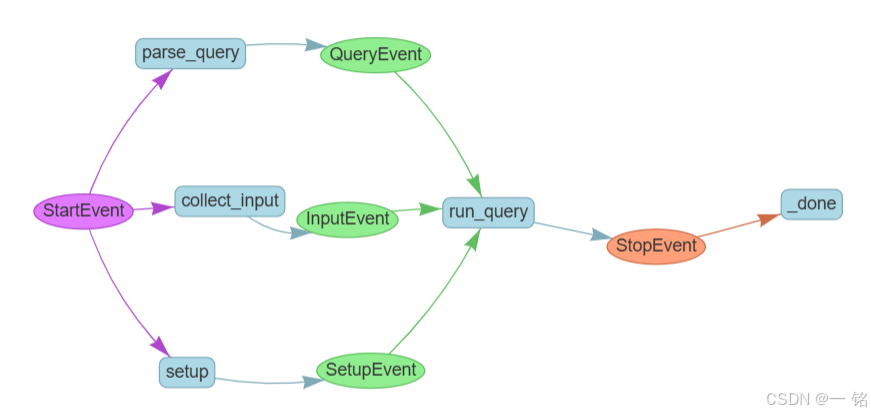
3.定义run_query处理步骤,该步骤要等到以上三个步骤执行完成后才开始执行。此时,就需要使用collect_events函数来协助把多个事件集中起来。
实现代码
from llama_index.core.workflow import (
Event,
StartEvent,
StopEvent,
Workflow,
step,
)
from llama_index.core.memory import VectorMemory
from llama_index.core import SimpleDirectoryReader, VectorStoreIndex, Settings
from llama_index.llms.ollama import Ollama
from llama_index.core.workflow import Context
import asyncio
import random
Settings.llm = Ollama(model="llama3.2", request_timeout=360)
class InputEvent(Event):
input: str
class SetupEvent(Event):
error: bool
class QueryEvent(Event):
query: str
#定义事件流步骤处理函数
class CollectExampleFlow(Workflow):
@step
async def setup(self, ctx: Context, ev: StartEvent) -> SetupEvent:
# generically start everything up
if not hasattr(self, "setup") or not self.setup:
self.setup = True
print("I got set up")
return SetupEvent(error=False)
@step
async def collect_input(self, ev: StartEvent) -> InputEvent:
if hasattr(ev, "input"):
# perhaps validate the input
print("I got some input")
return InputEvent(input=ev.input)
@step
async def parse_query(self, ev: StartEvent) -> QueryEvent:
if hasattr(ev, "query"):
# parse the query in some way
print("I got a query")
return QueryEvent(query=ev.query)
@step
async def run_query(
self, ctx: Context, ev: InputEvent | SetupEvent | QueryEvent
) -> StopEvent | None:
ready = ctx.collect_events(ev, [QueryEvent, InputEvent, SetupEvent])
# 等待所有事件都完成后才开始执行
if ready is None:
print("Not enough events yet")
return None
# run the query
print("Now I have all the events")
print(ready)
result = f"Ran query '{ready[0].query}' on input '{ready[1].input}'"
return StopEvent(result=result)
# 画出事件依赖图
from llama_index.utils.workflow import draw_all_possible_flows
draw_all_possible_flows(CollectExampleFlow, filename="CollectExampleFlow.html")
# 主函数
async def main():
c = CollectExampleFlow()
result = await c.run(input="Here's some input", query="Here's my question")
print(result)
# run main
if __name__ == '__main__':
asyncio.run(main())输出
运行后的输出如下:
<class 'NoneType'>
<class '__main__.InputEvent'>
<class '__main__.QueryEvent'>
<class 'llama_index.core.workflow.events.StopEvent'>
<class '__main__.SetupEvent'>
CollectExampleFlow.html
I got some input
I got a query
Not enough events yet
Not enough events yet
Now I have all the events
[QueryEvent(query="Here's my question"), InputEvent(input="Here's some input"), SetupEvent(error=False)]
Ran query 'Here's my question' on input 'Here's some input'
从以上输出可以看到,每个事件都被触发,并且收集事件重复返回 None ,直到足够的事件到达。
事件依赖图
小结
通过Context的ctx.collect_events函数,可以实现等待多个分支都成功执行后再执行指定步骤。

汇聚全球AI编程工具,助力开发者即刻编程。
更多推荐
 5
5 0
0- 0


 已为社区贡献13条内容

所有评论(0)