
探究多 Agent 协同体系中如何优化大模型微调数据对齐的消息路由与状态一致性
·
探究多 Agent 协同体系中如何优化大模型微调数据对齐的消息路由与状态一致性
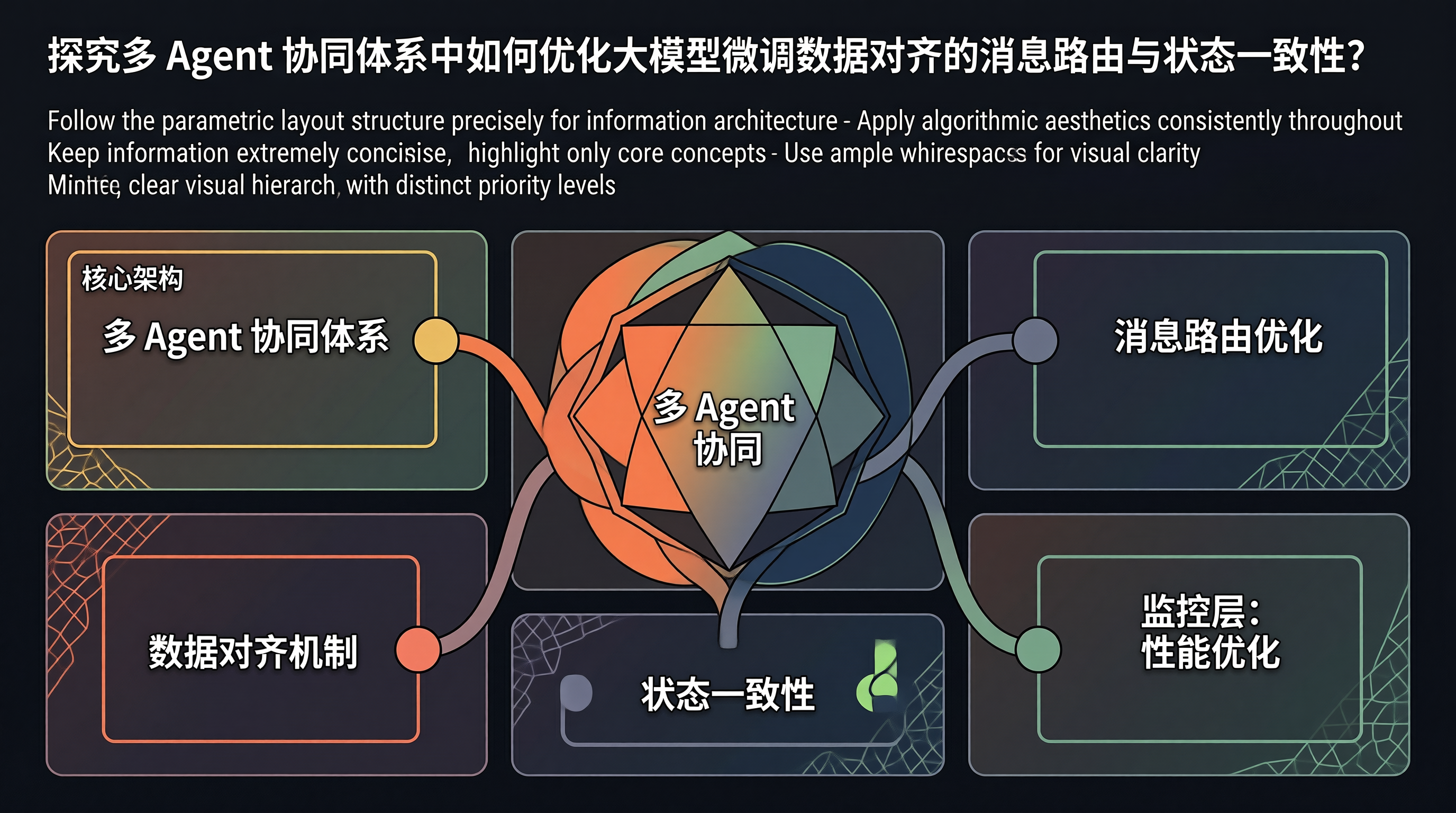
一、多 Agent 协同体系概述
在多 Agent 协同系统中,消息路由和状态一致性是保证系统稳定运行的关键。当涉及大模型微调数据对齐时,这些问题变得更加复杂。
flowchart TD
    A[多 Agent 协同体系] --> B[Agent 节点]
    A --> C[消息路由层]
    A --> D[状态同步层]
    A --> E[数据对齐层]

    B --> B1[Agent 1]
    B --> B2[Agent 2]
    B --> B3[Agent N]

    C --> C1[消息队列]
    C --> C2[路由策略]
    C --> C3[消息分发]

    D --> D1[状态存储]
    D --> D2[一致性协议]
    D --> D3[同步机制]

    E --> E1[数据采集]
    E --> E2[数据清洗]
    E --> E3[对齐策略]
二、消息路由优化策略
2.1 智能路由算法
class IntelligentRouter:
    def __init__(self):
        self.agent_capabilities = {}
        self.load_balancer = LoadBalancer()
        self.priority_queue = PriorityQueue()

    def register_agent(self, agent_id, capabilities):
        self.agent_capabilities[agent_id] = capabilities

    def route(self, message):
        candidates = self._match_capabilities(message)
        candidates = self.load_balancer.filter_by_load(candidates)
        candidates = self._filter_by_priority(candidates, message)

        if not candidates:
            return self._fallback_route(message)

        return self._select_best_agent(candidates, message)

    def _match_capabilities(self, message):
        matched = []
        for agent_id, capabilities in self.agent_capabilities.items():
            if self._capability_match(capabilities, message):
                matched.append(agent_id)
        return matched
2.2 动态负载均衡
class DynamicLoadBalancer:
    def __init__(self):
        self.agent_load = {}
        self.threshold = 0.7

    def update_load(self, agent_id, load):
        self.agent_load[agent_id] = load

    def get_available_agents(self):
        return [agent_id for agent_id, load in self.agent_load.items()
                if load < self.threshold]

    def distribute(self, tasks):
        available = self.get_available_agents()
        if not available:
            return self._handle_overload(tasks)

        distribution = {}
        for task in tasks:
            target = self._select_least_loaded(available)
            distribution.setdefault(target, []).append(task)

        return distribution
三、状态一致性保障机制
3.1 分布式状态管理
class DistributedStateManager:
    def __init__(self):
        self.replica_set = []
        self.consistency_level = 'quorum'

    def add_replica(self, replica):
        self.replica_set.append(replica)

    def update(self, key, value):
        ack_count = 0
        required = self._get_required_acks()

        for replica in self.replica_set:
            if replica.update(key, value):
                ack_count += 1
                if ack_count >= required:
                    return True

        return False

    def _get_required_acks(self):
        if self.consistency_level == 'strong':
            return len(self.replica_set)
        elif self.consistency_level == 'quorum':
            return (len(self.replica_set) // 2) + 1
        else:
            return 1
3.2 冲突解决策略
class ConflictResolver:
    def __init__(self):
        self.strategies = {
            'latest': self._resolve_by_timestamp,
            'priority': self._resolve_by_priority,
            'merge': self._resolve_by_merge
        }

    def resolve(self, conflicts, strategy='latest'):
        if strategy not in self.strategies:
            strategy = 'latest'

        return self.strategies[strategy](conflicts)

    def _resolve_by_timestamp(self, conflicts):
        return max(conflicts, key=lambda x: x['timestamp'])

    def _resolve_by_merge(self, conflicts):
        merged = {}
        for conflict in conflicts:
            merged.update(conflict['data'])
        return merged
四、大模型微调数据对齐
4.1 数据对齐流程
class DataAlignmentPipeline:
    def __init__(self):
        self.collectors = []
        self.cleaners = []
        self.validators = []

    def add_collector(self, collector):
        self.collectors.append(collector)

    def process(self, raw_data):
        collected = []
        for collector in self.collectors:
            collected.extend(collector.collect(raw_data))

        cleaned = self._clean_data(collected)
        validated = self._validate_data(cleaned)

        return validated

    def _clean_data(self, data):
        cleaned = []
        for cleaner in self.cleaners:
            data = cleaner.clean(data)
        return data
4.2 对齐质量评估
class AlignmentEvaluator:
    def __init__(self):
        self.metrics = ['accuracy', 'consistency', 'completeness']

    def evaluate(self, aligned_data, ground_truth):
        results = {}

        for metric in self.metrics:
            if metric == 'accuracy':
                results[metric] = self._calculate_accuracy(aligned_data, ground_truth)
            elif metric == 'consistency':
                results[metric] = self._calculate_consistency(aligned_data)
            elif metric == 'completeness':
                results[metric] = self._calculate_completeness(aligned_data, ground_truth)

        return results
五、协同优化架构
sequenceDiagram
    participant Client
    participant Router
    participant Agent1
    participant Agent2
    participant StateStore

    Client->>Router: 请求处理任务
    Router->>Router: 能力匹配 + 负载均衡
    Router->>Agent1: 分配任务A
    Router->>Agent2: 分配任务B

    Agent1->>StateStore: 获取状态
    Agent2->>StateStore: 获取状态

    Agent1->>Agent1: 处理任务A
    Agent2->>Agent2: 处理任务B

    Agent1->>StateStore: 更新状态
    Agent2->>StateStore: 更新状态

    StateStore->>StateStore: 解决冲突

    Agent1->>Router: 返回结果
    Agent2->>Router: 返回结果

    Router->>Client: 返回最终结果
六、性能优化与监控
6.1 监控指标
class SystemMonitor:
    def __init__(self):
        self.metrics = {
            'latency': [],
            'throughput': [],
            'error_rate': [],
            'consistency_violations': []
        }

    def record(self, metric_type, value):
        if metric_type in self.metrics:
            self.metrics[metric_type].append(value)

    def get_summary(self):
        summary = {}
        for metric, values in self.metrics.items():
            if values:
                summary[metric] = {
                    'avg': sum(values) / len(values),
                    'min': min(values),
                    'max': max(values)
                }
        return summary
6.2 自适应优化
class AdaptiveOptimizer:
    def __init__(self):
        self.monitor = SystemMonitor()
        self.thresholds = {
            'latency': 1000,
            'error_rate': 0.05,
            'consistency_violations': 0.01
        }

    def optimize(self):
        summary = self.monitor.get_summary()

        if summary.get('latency', {}).get('avg', 0) > self.thresholds['latency']:
            self._scale_out()

        if summary.get('error_rate', {}).get('avg', 0) > self.thresholds['error_rate']:
            self._adjust_routing()

        if summary.get('consistency_violations', {}).get('avg', 0) > self.thresholds['consistency_violations']:
            self._increase_replication()
七、总结
通过以上系统化的优化方案,可以有效解决多 Agent 协同体系中的关键问题:
- 消息路由:采用智能路由算法和动态负载均衡,确保消息高效分发
- 状态一致性:通过分布式状态管理和冲突解决策略,保证数据一致性
- 数据对齐:建立完整的数据处理管道和质量评估体系
- 自适应优化:基于监控数据自动调整系统配置
这些优化策略为构建高性能、高可靠性的多 Agent 系统提供了坚实的技术基础。

汇聚全球AI编程工具,助力开发者即刻编程。
更多推荐
 1
1 0
0- 0


 已为社区贡献53条内容

所有评论(0)